EPA Website Updated April 30th

According to an EPA website last updated April 30th:

“Many symptoms and human health effects attributed to inhalation of mycotoxins have been reported including: mucous membrane irritation, skin rash, nausea, immune system suppression, acute or chronic liver damage, acute or chronic central nervous system damage, endocrine effects, and cancer.”

The EPA added, “it is clearly prudent to avoid exposure to molds and mycotoxins.”

Full article – http://www.commondreams.org/archive/2008/07/05/10092/

Posted in Environmental Health Threats, Health - Medical - Science, Mold and Politics, Toxic Mold | Tagged , , , , , , , , , , , , , , , | Leave a comment

Louisiana rises to top of ethics rankings – Is this a joke?

5th in the US for its good government, transparency and accountability laws – thats only if these new laws were to actually work.  They will find a way around them legal or illegal.  What a joke!  katy

Article –

Louisiana continues to mine good will and potential economic capital from its rise in ethics rankings, with a national group ranking the state fifth-best in the U.S. for its good government, transparency and accountability laws.

If changes in state ethics laws this year were included, Louisiana would rank No. 1 in the overall ranking and in conflict of interest laws, according to the Chicago-based Better Government Association, which released its rankings today.

However, the BGA-Alper Integrity Index said no U.S. state has truly satisfactory ethics and accountability scores where government is concerned.

BGA’s Jay Stewart said Louisiana ranked 44th in conflict of interest laws before sweeping changes in legislation this year. Its index uses the latest ranking of such laws by the Center for Public Integrity, which date back to 2006. Were the 2008 changes included, BGA said Louisiana’s conflict of interest laws would rise from 44th to first and its overall ranking would move from fifth to first, displacing New Jersey. The BGA-Alper index ranks Louisiana third in open record laws, second in whistleblower laws, 20th in campaign finance laws and fourth in open meeting laws.

Louisiana’s economic development secretary, Stephen Moret, said the BGA ranking would boost its business expansion and recruitment efforts considerably. After New Jersey, the top states were Rhode Island, Hawaii and Washington. The bottom five were Montana, Tennessee, Alabama, Vermont and South Dakota.

Posted on – http://www.2theadvocate.com/news/business/businesstoday/monday/33366154.html#4

Posted in Politics | Tagged , , , , , , | Leave a comment

Moldy Existence – Louisiana Housing Finance Agency (LHFA) – HUD – Another Link to Corruption Between Businesses – Toxic Mold – Government

Moldy Existence
Louisiana Housing Finance Agency (LHFA) – Another Link to Corruption Between Businesses, Toxic Mold and Government.

Doc

Story: “Three years later, 6,500 subsidized New Orleans apartments fester”

by Katy Reckdahl, The Times-Picayune

More than three years after Hurricane Katrina, nearly 6,500 privately owned, federally subsidized apartments sit unrepaired in the state of Louisiana. Most — about 4,000 — are in the New Orleans area.

Before the storm, the apartments made up nearly 5 percent of the city’s total rental stock and about 40 percent of the subsidized housing affordable to extremely low-income residents, according to PolicyLink, a nonprofit housing research organization.

Built during the 1960s and 1970s, most of the apartments subsidized by the U.S. Department of Housing and Urban Development grew out of a federal effort to create more low-income housing by giving private developers low-interest, federally insured loans. Some properties have as few as a half-dozen apartments; others have hundreds. The effort, when it started, was HUD’s first stab at public-private partnerships, an approach it’s now using to remake the city’s Big Four public-housing developments: St. Bernard, Lafitte, B.W. Cooper and C.J. Peete.

But today, about 4,000 shuttered apartments across the city have gone largely unnoticed, despite the pitched public fights about the 4,534 public housing units demolished in the “Big Four” developments. (Before the 2005 flood, the Housing Authority of New Orleans operated about 5,100 occupied apartments in its public housing complexes.)

HUD did not provide detailed data on the number or status of all the subsidized rental properties, but information the agency gave politicians, researchers and housing advocacy groups suggests that about 800 of the apartments have reopened while 4,000 remain closed.

‘The biggest secret’

But it’s difficult to be exact, because the information coming from HUD is incomplete and hard to get.

“It’s like it’s the biggest secret in the universe, ” said Sen. Mary Landrieu, whose office has tried, unsuccessfully, to get detailed data from HUD about these properties.

In response to a request, HUD recently sent Landrieu a list of six properties that will be completed by March 2009 and a rudimentary progress report of 22 other metro-area properties including a brief status note, such as “foreclosure in process.” The list omitted at least five of the city’s unoccupied properties, home to nearly 400 subsidized tenants before Katrina.

The charts given to Landrieu reflected only properties that had “recovery plans, ” HUD spokesman Lemar Wooley said.

The recovery of the HUD-assisted apartments, Wooley said, has been delayed by the same factors that have affected the rebuilding of the city’s housing stock after Katrina: drawn-out battles over insurance, administrative delays and developer wariness of areas such as eastern New Orleans, where recovery remained uncertain for a while.

Housing advocates say the U.S. Department of Housing and Urban Development should take a more active role in reopening the affordable apartments, half of which were occupied by senior citizens. Without these rentals, they say, thousands of working poor, disabled and elderly people still live with relatives or struggle to pay steep post-Katrina rent.

HUD has yet to release a definitive plan that outlines which properties will reopen and which will not, and why. And since the properties are owned by a long list of private owners, it’s difficult to determine who’s doing what.

“Every deal is different, every property is different. That makes it hard to track what’s going on, ” said Laura Tuggle, head of the housing-law unit for New Orleans Legal Assistance.

Project-based Section 8

In many cases, HUD supplemented the loans to developers with per-unit monthly subsidies, which allowed landlords to collect market-rate rents while keeping tenants’ rent no higher than 30 percent of their income, the same threshold applied to public housing residents.

It’s known as “project-based Section 8, ” because the rental subsidies are attached to the physical apartments, unlike tenant-based Section 8 vouchers, which renters can use to lease any apartment.

In legislation signed into law last week, Landrieu inserted a provision streamlining the transfer of dormant HUD rental-subsidy contracts. If a property won’t be rebuilt, HUD can shift that subsidy to a new developer, who can use it to make its own financing more viable.

In May, Landrieu introduced the Gulf Coast Multifamily and Assisted-Housing Recovery Act, which includes more money for properties that house the elderly, along with higher rent subsidies to account for landlords’ increased costs. The bill has not been heard by the full Senate.

Instead of supplying affordable housing, some of the large apartment complexes present a massive blight issue. Especially in eastern New Orleans, neighbors and community groups are weary of the shuttered complexes, some of which were dilapidated long before the storm and are now considerably worse, said Landrieu spokeswoman Stephanie Allen.

Concentrated in the east

Before Katrina, the subsidized apartments were a key strategy for housing the poor.

The lion’s share of the project-based properties are in eastern New Orleans, which was being developed during the 1960s and ’70s when HUD first implemented the program. HUD discontinued the program in 1983 and has moved toward tenant-based vouchers, which the agency contends are less costly and less apt to concentrate poor renters in one area.

But by then, nationally, the program had created a huge stock of privately owned, federally subsidized housing: 1.5 million apartments in 2007. That’s more than the nation’s total units in public-housing complexes, which numbered 1.2 million in 2007, according to HUD.

In New Orleans, for the elderly who rented about half of the city’s subsidized units, rent might be $150, depending on the size of their monthly checks. A family headed by a short-order cook making $16,000 a year would pay $427 in rent.

But Christopher Homes, which provides housing for the elderly through the Archdiocese of New Orleans, didn’t plan the renovation of Nazareth Inn’s 270 subsidized apartments until the city’s plan for eastern New Orleans were clear, said executive director Dennis Adams.

Nazareth won’t reopen until the end of this year. Because many of his senior citizen renters don’t have cars, he worried about the return of grocery stores and pharmacies within walking distance. “For us, it’s all about mission, ” Adams said, “but we have to operate with good business sense.”

. . . . . . .

Katy Reckdahl can be reached at kreckdahl@timespicayune.com or 504.826.3396.

Nola

Posted in Environmental Health Threats, Toxic Mold | Tagged , , , , , , , , | Leave a comment

2007 Mold Inspection Report – More Pages – Jefferson Lakes Apts – Riverstone Residential – Louisiana Housing Finance Agency

This test was conducted in order to facilitate the identification of possible biological agents present on interior surfaces at Jefferson Lakes Apartments 12400 Jefferson Hwy. Baton Rouge, LA. 70816.

These pages from the report contain the type of testing that was done in 6 apartments in the Phase 3 buildings along with the results and recommendations.

The results show HIGH levels (in 3 of the 6 and low to medium in 1) of apparent microbial growth which is not consistent with naturally occurring conditions.

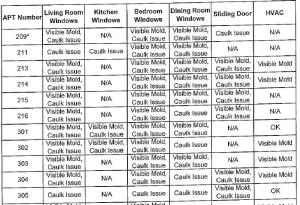
Again, as in the 49 units of the 76 inspected in Phase 1 & 2 that have mold in the HVAC system these do too. Also included are the recommendations of the visual inspection of apartments in phase 1 & 2 buildings that were posted earlier.

Riverstone Residential, after knowing of my 2005 report documenting MOLD continues to deny they know of mold and continues to say no one reports mold!

I called the The Louisiana Housing Finance Agency and told them of my 2005 IAQ – Microbial – Fungal Report. I did not know about this 2007 report when I called and it is hard to believe they did not know about it since they were involved in the sale of this complex when the report was done. The person I spoke with said they would certainly be concerned about a problem like this. He wanted me to send a copy of my report but I believe they are supposed to investigate reports or complaints without a very expensive professional report which most people making a complaint would not have.

People are living there now.

Years of mold growth has resulted in high levels of poisons.

They still allow people to move in even with documented evidence of the TOXIC ENVIRONMENT including INFANTS and CHILDREN.

1-cover-a2
k-mi-11k-mi-2k-mi-3mipg5k-mi-4k-mi-5

Posted in Environmental Health Threats, Louisiana Housing Finance Agency, Mold and Politics, Mold Litigation, Riverstone Residential, Toxic Mold | Tagged , , , , , , , , , , , , , , , , , , | Leave a comment

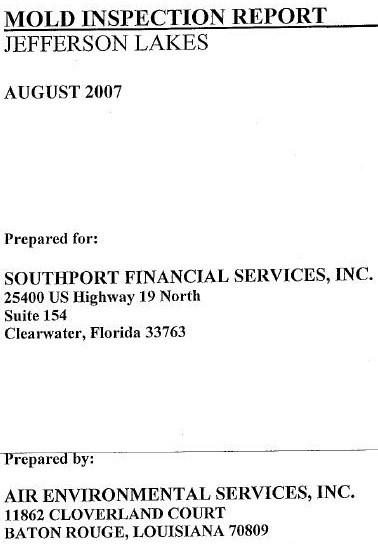
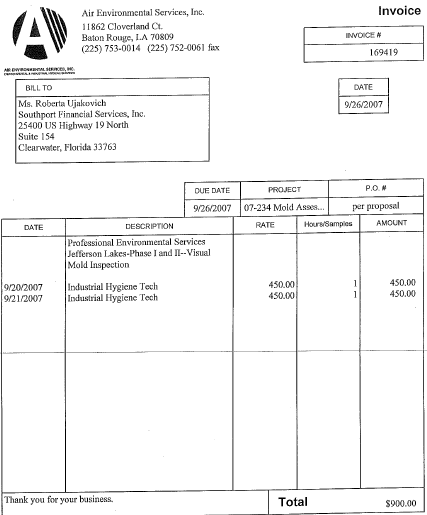
2007 Mold Inspection Report – Jefferson Lakes Apts – Riverstone Residential – Louisiana Housing Finance Agency

This Mold Inspection Report was performed during the time this complex was involved in a sale with the Louisiana Housing Finance Agency.

My report (which will be posted soon) was done in 2005.

In March of 2008 a motion for summary judgement was granted to Riverstone Residential because the Judge said we did not show that management knew or should have known of this mold infestation that has been growing in these buildings for years. More on the history of these buildings and why they are so infeseted with years of mold growth to come.

The Judge’s wife is the Commissioner of Administration and on the State Bond Commission that in 2007 approved the sale of this complex.

My attorney had knowledge and a copy of this report. Not that we needed more proof that they had been hiding this for years and still are, but he did not mention this report in court or to me. Everything has been manipulated (illegally) to keep this from even going to court.

The supoena for records from the company who did this report was for records from 2005 and three years previous to see when they had tested there before but they sent 2005 and years after. This was the same case with Guarantee Systems, they sent assorted records for 2004 and after. They have done an unbelievable amount of air and dryer duct cleaning at the complex and this too was done specifically to not provide certain information.

I posted another instance of manipulation with an affidavit – yes – by my attorney – to avoid providing certain records and will repost it here.

I will post my repeated questions to my attorney as to why we do not have records for the right years along with his obvious and total avoidance to acknowledge the question or respond.

To find out that your basic rights can be abused by others and then abused again and then denied by the justice system and your own attorney – and all this after being exposed to that mold infested and toxic apartment (especially with a baby) is almost too much to comprehend.

This cannot just go away. katy

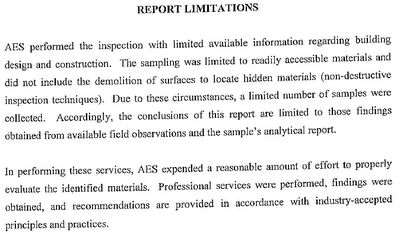
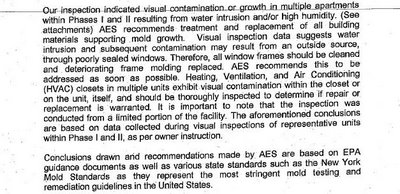
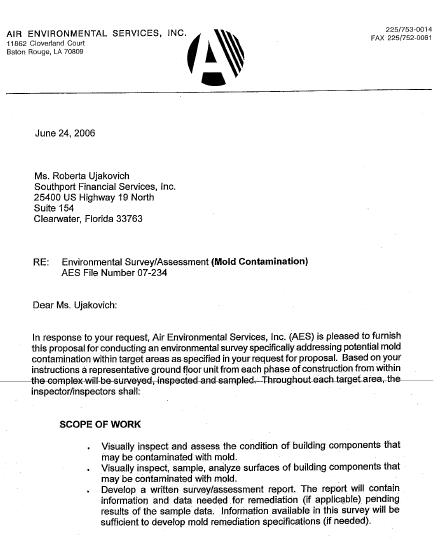
This is one part of the report.

These pages show apartments that were visually inspected for mold and the results. 49 out of just the 76 that were actually inspected show VISUAL MOLD in the HVAC system!

Riverstone Residential, after knowing of my 2005 report documenting MOLD denies that they know of mold. And they continue to say there are no reports of mold.

I called the The Louisiana Housing Finance Agency in 2008 and told them of my 2005 IAQ – Microbial – Fungal Report. I did not know this 2007 report was in existence at the time I called. The person I spoke with said they would certainly be concerned about a problem like this. He wanted me to send a copy of my report but I believe they are supposed to investigate reports or complaints without a very expensive professional report which most people making a complaint would not have.

I find it hard to believe that this 2007 report was not known since all were involved in a transaction with this complex.

inv

Posted in Environmental Health Threats, Louisiana Housing Finance Agency, Mold and Politics, Mold Litigation, Riverstone Residential, Toxic Mold | Tagged , , , , , , , , , , , , , , , , , , | Leave a comment