Posted by PUPPETGOV on Aug 14th, 2009
By Daniel Terdiman – CNET
Don’t let anyone ever tell you that New Orleans is doing just fine three years after Hurricane Katrina.
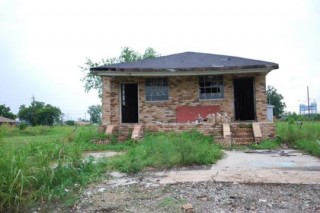
Despite media reports that New Orleans is recovering nicely from Hurricane Katrina, there are still parts of town–like the poverty-stricken Lower Ninth Ward–where recovery is far from the reality. Instead, condemned houses like this one, or entirely overgrown lots, are the norm. (Credit: Daniel Terdiman/CNET News.com)
Sure, it’s true that some areas of the city, like the French Quarter or the Garden District, seem back to normal, with swarms of tourists, drinks flowing, and the leisurely pace and laid-back attitude the city is famous for on full display. And it’s also true that there are parts of town where you’d never know anything bad happened.
But in the Lower Ninth Ward, the poverty-stricken part of New Orleans that took the biggest hit from the 2005 storm and the floods that followed, a sign I saw on Sunday perhaps sums up exactly what is going on there:
“Tourist,” the sign exhorts, “Shame on you, driving by without stopping. Paying to see my pain. 1,600+ died here.”
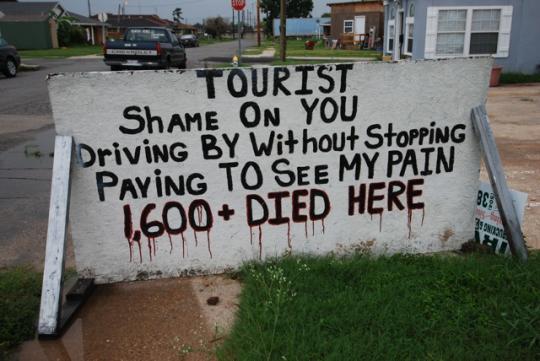
This sign, in the Lower Ninth Ward, is aimed at tourists who come through the neighborhood on bus tours and is meant to remind those visitors that Hurricane Katrina exacted a horrible human cost that was largely paid by residents of poor areas like this. (Credit: Daniel Terdiman/CNET News.com)
The truth is, the Lower Ninth Ward is an unmitigated disaster area, a wasteland, a battle zone, an abandoned community, and a national shame, all rolled into one.
For block after block after block, in any direction, the area is still, even today, in ruins. No matter how much anyone wants to sugarcoat the situation on the ground here in the Big Easy, no matter how much the city wants to convince the tourists that all is well, it isn’t even close to OK.
And it is far from the only district of town that is still suffering. During two days I spent driving around New Orleans as part of my Road Trip 2008 project, I saw neighborhood after neighborhood where boarded-up buildings abound, where empty lots stand out starkly between rebuilt structures, and where groups of nicely redone dwellings are across the street from shells of houses that in other cities would be seen as embarrassing blights. Here, they are business as usual nearly three years after Katrina smashed into this city.
But compared with these areas, the Lower Ninth Ward still stands out.
If you’ve never seen anything like this, you can’t really prepare for it. I’d heard people whispering that the reality here was very different than the picture being spread in the media, and I wanted to see for myself.
It was worse than I even imagined. This is a huge area that was once jammed with housing, and people. To be sure, the housing was poorly constructed and living conditions no better. Today, the dominant feature is weeds taller than most people. Buildings are few and far between.
Reconstruction and recovery? Not so much.
You can debate the reasons behind this all you want. But whatever is responsible for this, one thing is clear: This is a significant area of a major U.S. city that will likely never come back.
And, to make matters worse, what recovery there has been is under constant threat as any future hurricane that hits New Orleans could easily cause further disastrous flooding, as the protections put in place since Katrina are by no means yet up to the task of protecting this area against a similar catastrophe.
Before I could see all this, though, I met up with Sakura Kone, who coordinates media and event relations for the community group Common Ground Relief.
Kone suggested we meet at the Wesley United Methodist Church, a house of worship that was built in 1838 by slaves and which was badly damaged during Katrina.

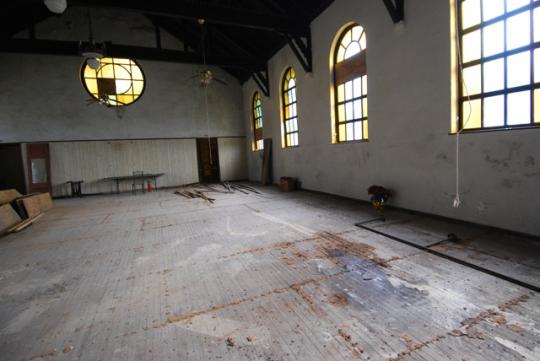
The sanctuary at the Wesley United Methodist Church, which suffered heavy storm-related damage during Hurricane Katrina. Though it wasn’t flooded, its roof was badly damaged and it later incurred severe leakage that ruined the floors. The community group Common Ground Relief is working to renovate the church, which was built by slaves in 1838. (Cedit: Daniel Terdiman/CNET News.com)
Unlike much of the city, this wasn’t flood damage. Rather, the church’s roof was battered by the hurricane and ever since has leaked whenever it rains. That means that in the three years since the storm, the place has suffered through all kinds of water damage, toxic mold build-up, and general disrepair.
Now, the group is attempting to renovate it, employing a series of volunteers, many of whom live there, to do the work.
The idea is also to coordinate Common Ground Relief’s skills training here, the idea of which is to give community members carpentry, electrician, and plumbing education, to name a few. But the group is largely on its own, said Kone, with no help from the New Orleans city government.
That means renovating the church is a slow process because of Common Ground Relief’s few resources.
But the group is working hard to help the disadvantaged and often displaced residents of New Orleans get back on their feet, even if the efforts are painfully slow.
For example, in the Lower Ninth Ward, Kone explained, Common Ground Relief has helped residents get back into houses that were all but destroyed by the calamity that flooded in with the storm surge driven by Katrina and the breached levee that is just adjacent to the district.
And while it’s true that here and there, a few remodeled houses stand out amid the ruins of the entire neighborhood, they are few and far between. Literally.
Much more common here are weeds, abandoned lots, destroyed structures, and the sense that you’re in the middle of an apocalyptic wasteland, not a former urban neighborhood.
One thing that really struck me as we drove around the Lower Ninth Ward was how hauntingly quiet it was. This was a neighborhood of 30,000 people before Katrina, and now you can drive for block after block after block without seeing a person or a moving vehicle. It sort of looks like a park, given how overgrown the weeds are here, but when you remember that this was a jam-packed neighborhood where most of the nearly 2,000 people who died in the disaster lived, you snap back to reality.
And it’s important that America and the world not forget what is going on in the Lower Ninth Ward and in other heavily damaged parts of New Orleans. What most people see on TV these days from the city are images of tourists partying during Mardi Gras or Jazzfest or of sporting events going off as per usual.
And those are good things, to be sure. It’s definitely crucial that the city has some fully or nearly recovered areas, as one of the major industries here is tourism, and New Orleans needs visitors’ dollars.
But the less the image of the destruction that’s still everywhere is spread around, the less people will care about helping–or about ensuring that such a disaster doesn’t happen again.
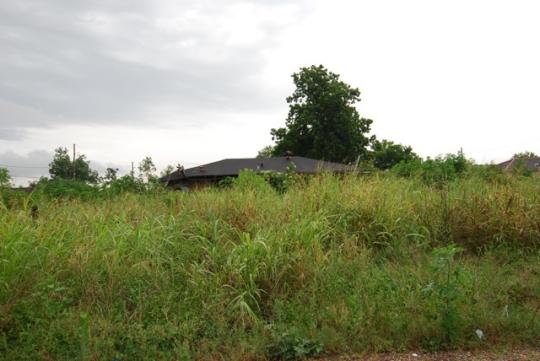
In the Ninth Ward, most houses were simply swept away. Today, nearly three years after the hurricane, it is more common to see empty lots with weeds than rebuilt houses. Those houses that still exist are frequently condemned. The community group Common Ground Relief estimates that just one in 10 of the 30,000 pre-Katrina Lower Ninth Ward residents lives there today. (Credit: Daniel Terdiman/CNET News.com)
In the meantime, however, groups like Common Ground Relief are working hard to help the people who are least able to help themselves–the poor, mostly African-American people who have little choice but to play the very bad cards they’ve been dealt.
To be sure, there are many efforts afoot from outside the city to help.
For example, actor Brad Pitt has pledged to raise tens of millions of dollars for new housing in the Lower Ninth Ward.
But when you see the scale of the problem, you realize that that’s just scratching the surface. And that’s why the skills training that Common Ground Relief is offering people is so needed: So people can take it upon themselves to start working on infrastructure.
Common Ground Relief is also organizing what it calls a Community Adoption Program, Kone said. This is a plan to get people who can afford to do so–either in or out of the city–to adopt houses, churches, or even whole blocks, and help pay for their renovation.
The group is also offering free legal advice to residents, an important resource given that many people are facing onerous deadlines or regulations regarding the condition of their houses. For example, the city of New Orleans is requiring all travel trailers to be off people’s property as of July 1 unless they file for an extension.
Similarly, there are regulations about how damaged or destroyed houses are boarded up, violations of which bring daily fines of hundreds of dollars.
But with insurance money hard to come by, many residents have no other way to occupy their land or fix up their dwellings according to city specifications.
Another problem, Kone said, is that the wetlands adjacent to the Lower Ninth Ward have been eroded over the years due to neglect by the city and industry that allowed salt water to seep in. The result is a loss of a first-line of defense against flooding.
So Common Ground Relief is working hard to plant millions of plants in the wetlands to try to strengthen the soil for the future.
Still another problem is that vast areas of the city that were flooded have poisoned soil due to the mercury, lead, arsenic, and asbestos that came in with the water. So Common Ground Relief is also working on what Kone called bio-remediation, a process of planting sunflowers, mustard greens, and mushrooms that can draw out the poisons.
This is profound, depressing, and stunning stuff. It’s amazing to think that nearly three years after the disaster, a prominent U.S. city still has massive areas that are nowhere near recovered.
But there is hope, even if it is only a spark. And for people like Kone and the residents of the Lower Ninth Ward who are still there, or who have come back, that has to do for now. Because that’s all they’ve got.
blog.puppetgov.com



 Katy's Exposure