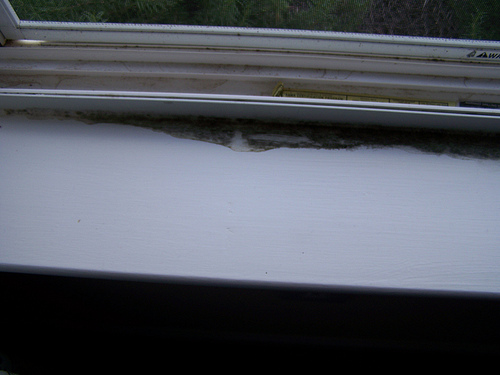
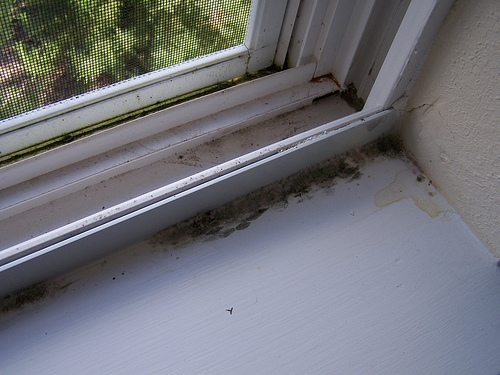
A mold problem (among many others) at Alexan Laguna Beach Apartments in Panama City Beach managed by Riverstone Residential – A Tenant’s Experience & Photos

Shortly after we moved in to the brand new apartment and apartment complex, we had a pretty bad rainstorm.  It was then that we noticed water leaking from the inside door frame of the glass door leading to our screened in porch.  It was literally leaking from the molding surrounding the door.  After contacting maintenance, two men came to check out the problem.  They told me the problem was that the wind was blowing rain so hard that it made its way through the porch area of the apartment directly above me and pooled there and was leaking down.  They told me that the wind caused this and it wouldn’t happen again.  They didn’t fix or repair anything in my apartment. 

The next problem I encountered was a massive bug problem.  We were constantly battling spiders, roaches, unknown bugs I have never seen before, and my favorite, scorpions.  After calling management and complaining about finding a scorpion in my apartment, they told me this was common in Florida.  I have lived in Florida for 22 years and never seen a scorpion in my house.  I requested that the pest control visit my apartment again (for the second time that month), and they never came. 

The next problem we had involved mold!  We found mold growing on our ceiling in the hallway leading to my little boy’s bedroom. 8 months after we moved in to this brand new apartment.  The maintenance man came out and sprayed mold killer on it and then painted over it.  He then informed me that there was a leak in the bathroom that connected to the hallway and that he repaired it. 

Two weeks after this, we found mold growing on the wall in my little boy’s room.  He informed me that the reason is because the air circulation in his room was not good because we had too much furniture in it.  We had two twin beds, a dresser, and a nightstand.  The wall with the mold on it had nothing in front of it.  There was a bed right next to it where my little boy slept.  I told him I didn’t think that was accurate and he just kept repeating himself.  He told me that he will clean it up for me this time but that I need to keep my blinds and windows open to let air into the apartment.  I told him that the thermostat was kept at 70 degrees.  He told me that I shouldn’t keep it on in the winter and that I need to air out my place. 

Next, I showed him the windowsills.  They were constantly growing green and pink stuff.  He told me that this was my fault and that I need to keep the blinds open more.  I opened my blinds every single day from morning until night (unless I was sleeping).  I told him this but he just kept repeating himself.  He couln’t give me any other reason or explanation.  There was a big crack in the wall next to the window that water stains were congregating around and he just kept telling me that I need to keep my windows and blinds open. 

Next, the gates to enter and exit the apartment were constanly kept open.  If they were closed, you would need a key card to get in, but they never were.  They advertised a gated community but they kept the gates open solidly for two months.  Finally, one day they decided to shut the gates.  The very next day, we received a letter stating that we need to be careful and keep our doors and windows locked because there have been multiple breaks ins and even a forced entry into one apartment.  I can’t tell you how glad I am that the maintenance man was dispensing advice to open all windows to air our my apartment while the management is telling me to keep everything locked. 

We had enough and moved out.  Unfortunately, we are still battling the Alexan Laguna Beach.  We had given them our 60 days notice to vacate and turned in our keys to a proefessionally clean apartment on the day the lease expired.  Fully expecting our deposit back, we were surprised to find that they were taking our security deposit and billing us for the replacement of the carpet in the entire apartment.  There was general wear and tear of the carpet with a few small spots but nothing that would require the entire carpeting to be replaced.  This is absolutely unnecessary.  Even though this was a brand new apartment, when we moved in there were paint splatters on the carpet in multiple rooms.  In addition, the areas where the carpeting in the living room would join the carpeting in the bedroom was coming up.  A visible line with strings coming out was what you saw when the carpeting connected.  This was all noted in the damage report, yet they are still trying to charge me to replace all of the carpet in the apartment.  Furthermore, they are charging very close to the maximum allowed.  On the replacement charges listed on back of the damage report, it says the charges vary on size of the apartment.  We had the smallest two bedroom apartment at the complex.  They were telling me it basically cost them as much to replace the carpet in a small 2 bedroom as it does in the large 3 bedroom.

In addition to all of that, they are also sent us a statement charging us rent for the month after we vacated the apartment even though I have documentation stating that our lease expired and my notice given.  My lease had expired and I had given them my 60 days notice, yet they are still trying to bill me for a month after I had moved out when I wasn’t even living there.  Furthermore, I have tried repeatedly to contact the assistant manager that sent me the statement, and she refused to return any of my phone calls.  When I called, she was too busy or never there, or finally the last call I made, she refused to talk to me.  I have now filed a complaint with the Better Business Bureau, and I am hoping they can get a response out of her because I sure can’t!!

mold-window

mold-window 2

mold growing on wall


Note – Information on Riverstone Residential knowingly exposing tenants to extreme amounts of mold toxins at Toxic Mold Infested Jefferson Lakes Apartments in Baton Rouge, Louisiana.  katy

Toxic Mold Infested Jefferson Lakes Apartments managed by Riverstone Residential

Riverstone Residential Litigation

Mold Inspection Reports

Photos of Mold in Apartment

 
Posted in Environmental Health Threats, Mold Litigation, Photos, Riverstone Residential, Toxic Mold | Tagged , , , , , , , , , , , , , , , , , , , , | 1 Comment

Coming Up – A mold problem at Alexan Laguna Beach Apartments in Panama City Beach managed by Riverstone Residential – a tenant’s experience & photos

And of course Riverstone Residential’s lies and attempts to cover it up and actually blame it on the tenant.

Posted in Mold Litigation, Riverstone Residential, Toxic Mold | Tagged , , , , , , , , , , , , , , , , , , , , | Leave a comment

ToxLaw.com – Dr. Thrasher provides more detailed & accurate information – Oak Ridge School mold

Posted by Sharon on 6/28/09

I have never heard of warnings to not retaliate against employees. Is that a standard aspect for a state DOL document?

Also, I am not aware of anyone ever finding T-2 Toxin in building materials. Are you? Tricothecenes, yes. T-2, no.

I am no scientist, nor have I read any documents from this school and can only go on what is in the newspaper. From what I am reading, I think it sounds like that ventilation system has got some serious problems. I heard there was a teacher who retired early due to illness and now the teacher that took over the room is also pretty sick. The kids in that room have had a
lot of problems, too. That is not an untypical situation.

But for 75% of the teachers and 50% of the kids to have complaints, that is pretty unusual. It seem like it has got to be the ventilation system to cause that, unless there is just a whole bunch of unmitigated leaks, or they left the moldy materials in after they fixed the leaks. With all the money they have already spent to figure out this problem, that doesn’t seem logical to me.

Also, Dr. Thrasher has written on sickbuildings, clarifying some of the quotes that were attributed to him.

“I have a few comments to correct some misinterpretation of my conversaton with Paul Clark.

1. The T-2 toxin test recommended by Linda May (I have a copy of her resume, pathetic, in case anyone wants a copy) is marketed by an entity not associated with Dr. Hooper. The T-2 toxin kit was developed and is sold for testing for mycotoxins in foods. It detects moncyclic (T-2 toxin)trichothecenes. It has not been approved by the FDA for use with human urine. It does not test for Mold DNA by PCR.

2. Dr. Hooper took the T-2 kit concept, developed his own patented method and can test for macrocyclic trichothecenes, aflatoxins and ochratoxins in human body fluids and in biopsy and autopsy specimens. His laboratory has undergone CLIA inspections and passed honorably. He is allowed to use the test for human diagnostic. The FDA does not approve or recommend any diagnostic test. For example, CBC, blood chemistry, skin allergy tests, IBT hypersensitivity pnemoniitis panel, etc. are not approved by the FDA. The testing laboratories must undergo CLIA inspections. If they pass the inpsection then they are allowed to perform the diagnostic tests.

3. Mr Kreis is not up on the literature regarding molds and where mycotoxins are found. All should be aware of the research by Dr. Brasel and Dr. Kraus as well as that of Dr. Gorny. Fine particulates (<2 microns) are shed from mold and bacterial colonies at frequencies of 1 to 20 hertz. These frequencies lie in normal human activity, e.g. talking, walking, TV, radio,
etc. The fine particulates are up to 320 times more concentrated than are mold spores and hyphae. Mycotoxins and other toxins are present in this fine particulate fraction. As a matter of fact, Drs. Brasel and Straus demonstrated the presence of trichothecenes in these fine particles and in the sera of individuals exposed to Stachybotrys in contaminated buildings. Finally, Dr. Lewis has demonstrated the presence of gliotoxin in the sera of patients with aspergillosis. Gliotoxin is produced by species of Candida and Aspergillus.

4. Dr. Hooper has developed and patented a very sensitivie PCR mold DNA test that is very accurate. Although the ERMI test my produce results that overstate the extent of the contamination, nevertheless, it is still useful for determining mold species in the indoor and outdoor environments. Dr. Hooper’s test is even more reliable for bulk samples and can also be used to
detect mold DNA in biopsy and autopsy materials.

5. The press, M.D.s, and others keep citing the Institute of Medicine Report as a reliable source. I must remind everyone that the IOM cut off for its literature review was in October, 2003. Therefore, the IOM report is outdated by almost 6 years. It also missed key papers, particularly those published after the cutoff date, e.g. Drs. Crago, Gray, Kilburn, Brasel,
Straus, Gorny to mention a few.

6. We must commend and thank Sharon Kramer for gettin the GAO report accomplished on mold. This report concluded that there is evidence that mold is a health problem and more research is needed in this area. I agree.

7. Note in the article on the Oak Ridge siluation that remediation was done. Testing of molds was done after remediation for the most part. The majority of sampling was for airborne spores, which only represents that specific time and day. Dr. Robinson of the Health Deparment stated that hidden mold is not important (Tsk, Tsk).

8. Again, emphasis is being placed only on molds. Bacteria (gram negative and positive) grow along with the mold. The potentially dangerous gram positive bacteria include Actinobacter (Streptomyces, Nocardia and Mycobacterium), which can be human pathogens and which do produce toxins of their own. For example, Streptomyces species is the source of toxic antiobtics as well as chemotherpeutics. Mycobacterium can cause hypersensitivity pneumonitis, can be infectious (mycetoma) and Mycobacteriu Avium Comples (MAC) is on the increase World Wide in both immune competent and immune incompetent individuals. As a matter of fact, so is Aspergillosis. The tram negative bacteria are potential pathogens and release endotoxins.

If you want to become educated on the indoor environment and its potential health effects, I suggest that you do a search of the literature via entrez pubmed as well as Google. I am through and will get off my high horse.

Jack D. Thrasher, Ph.D.
Toxicologist/Immunotoxicologist/Fetaltoxicologist
www.drthrasher.org
toxicologist1@msn.com…”

Will be interesting to see what the problem really is and how
they find it.

toxlaw.com

Posted in Environmental Health Threats, Health - Medical - Science, Toxic Mold | Tagged , , , , , , , , , , , | Leave a comment

State Wades Into Oak Ridge Mold Mystery

by Paul C. Clark
Staff Writer
June 25, 2009

The pressure on Guilford County Schools to solve the mystery of health symptoms reported by students and parents at Oak Ridge Elementary School is increasing.

Students and parents at the school have reported persistent and increasingly severe symptoms at Oak Ridge since it was completely rebuilt in 2005.

On June 15, the Occupational Safety and Health Division of the North Carolina Department of Labor (NCDOL) , which investigates complaints of hazardous workplace environments, wrote to Guilford County Schools with the first official complaint from Oak Ridge employees and parents, ordering the school system to investigate the conditions at Oak Ridge and report its finding to the NCDOL by June 24.

The complaint released by the NCDOL said that employees at the school are exposed to mold inside the HVAC unit, walls and carpet of the school, and that employees are experiencing adverse health effects, including skin rashes, headaches, nosebleeds, fever, blurred vision, sore throats and fatigue.

The NCDOL wrote to Oak Ridge Elementary School on June 15 stating that the agency has not yet determined whether or not the hazards alleged in the complaint exist, and isn’t conducting an independent investigation of the school at this time. But the agency ordered the school to conduct an investigation, and to correct any environmental hazards found.

“Within seven working days of your receipt of this letter, please advise us, in writing, by certified mail of your findings and of the action you have taken,” the NCDOL wrote. “Your response should be detailed, stating specifically what actions you have taken to correct each hazard. You should enclose any supporting documentation, such as monitoring results, equipment purchases, photographs, etc.”

The NCDOL also warned the school system not to retaliate against any employee involved in filing the claim, citing the North Carolina statute against such retaliation.

The NCDOL wrote that the North Carolina Occupational Safety and Health Act allows it to issue citations and penalties to the school if the school system doesn’t adequately respond and the NCDOL has to investigate the building itself.

The NCDOL wrote, “If we do not receive a response from you within seven working days indicating that appropriate action has been taken, or that no hazard exists and why, an inspection may be conducted.”

The NCDOL’s involvement is just the latest chapter in the Oak Ridge saga, which dates to the 2005 rebuilding of the school. In addition to the health symptoms, parents and teachers at the school have reported persistent water leaks in the building since then, and internal and third-party inspections began turning up mold in the floors, bathrooms and heating, ventilation and air-conditioning system of the school at least as early as 2007, the earliest date for which records are yet available.

Some parents and teachers at the school accuse Guilford County Schools of inaction on Oak Ridge. Others say the school system has been responsive, but obviously has not yet found the cause of the problem, which, according to a survey of symptoms released by the Guilford County Department of Public Health on June 12, increased between the 2007-2008 and 2008-2009 school years.

One toxicologist, Jack Thrasher, said Guilford County Schools hasn’t done specific enough tests to identify any mold-related health risks at Oak Ridge.

Thrasher is a California toxicologist who has reviewed some of the test results done over the past two years at Oak Ridge. Unlike Linda May, the self-proclaimed mold expert who has grabbed the spotlight in recent weeks in the Oak Ridge controversy, Thrasher provided a resume that lends credence to his opinions. He’s a Ph.D., not a medical doctor, but his resume lists the things you’d expect to find in an environmental expert: a 1964 doctorate in human cellular biology from the University of California School of Medicine, professorships at the University of California School of Medicine and the University of Colorado School of Medicine, numerous publications in peer-reviewed journals on the medical effects of environmental hazards, bearing titles such as, “On the Neuropsychological and Electrocortical Impacts of Mixed Mold Exposure,” and numerous memberships in scientific societies.

We haven’t verified all of the material on Thrasher’s resume – news outlets rarely do, unless, as with May, there are reasons to doubt a person’s qualifications – but we have no reason to doubt them. Like May, Thrasher works as a consultant on issues of mold and other environmental contaminants. Unlike May, Thrasher shows a precise knowledge of the peer-reviewed literature on mold, the chemical and biological tests for mold exposure, and the medical effects of exposure to mold and other contaminants. He may be right or wrong, but he’s not speaking from ignorance.

Thrasher reviewed some of the tests done by Workplace Hygiene, the industrial-hygiene firm hired by Guilford County Schools to test the air and carpets at Oak Ridge, and said he found them lacking. “Those were all standard testing, but it’s incomplete testing,” he said.

Thrasher said that the tape-lift and air tests done at Oak Ridge are fine, but should be followed up with dust tests to measure the school on the US Environmental Protection Agency’s “Environmental Relative Moldiness Index.” Such DNA tests of mold found in dust identify 36 types of mold more precisely than air tests and tape lifts, and supporters of dust tests say they are more useful in diagnosing the danger level posed by mold in a building. Others say dust tests are useful, but don’t correlate directly to known health symptoms – and that positive results on the dust test show a need for more investigation, rather than proving a causal effect by the mold on reported health symptoms.

Thrasher reviewed the vacuum-sample tests and tape lifts done on carpets at Oak Ridge and said they were probably valid.

“That would indicate to me that there is very little mold being held by the carpets, and I see nothing wrong with that,” Thrasher said. “But what I’m concerned about is what’s in the HVAC system.”

Thrasher said that, in addition to the dust tests, Guilford County Schools should do bulk tests on any mold-contaminated building materials found at Oak Ridge. In other words, if the school system finds a mold-contaminated section of wall board, it should do DNA testing on that part of the wall.

Thrasher also suggested that the school system do a gas chromatographic mass spectrometer test for microtoxins on samples taken at the school, using even more specialized high pressure/performance liquid chromatography (HPLC). He said, “It’s a complex test which can be done, but which they appear not to have done.”

Thrasher said that dust tests are more reliable than tests for mold spores, such as Guilford County Schools has had done, because specialists have demonstrated in studies that mold-related microtoxins are found in fine particulate matter, not just in spores – and that contaminated dust can enter the alveoli of human lungs and thus enter the bloodstream.

May is trying to sell parents and teachers at Oak Ridge DNA tests for human urine. Thrasher said that DNA tests on human tissue, or on mold-contaminated materials, are valid – but that he doesn’t consider the type of test May describes valid.

“I doubt very much that you’re going to find mold DNA in the urine, unless there’s severe kidney infection,” he said. “The woman doesn’t know what she’s talking about.”

Thrasher said that a test for T-2 microtoxin – a microtoxin found in molds and, in a highly purified form, used as a weapon – has been developed, but by Dr. Dennis Hooper of RealTime Laboratories of Dallas. He said that test has not yet been approved for use in humans.

Brian Kareis, an industrial hygienist with Workplace Hygiene, agreed with most of Thrasher’s assessments, and welcomed his input on future tests at the school.

“Most of the typical things have been done,” Kareis said. “You can test and test and test, but unless you have a direction, you’re kind of at a loss. I’m certainly willing to listen to an outside expert.”

Kareis said that most of what he’s read indicates that microtoxins stay in mold spores and shouldn’t be found in loose particles. He said the samples taken so far have been run through a mass spectrometer, but not using the newer HPLC method, or testing for DNA sequences. He said that the DNA tests are expensive, and tend to err on the side of generating positive findings that may not actually be causing health problems.

Kareis said many of the connections claimed between mold and health problems have not yet been proven, and that federal and state regulations have not yet caught up with the mold health debate by establishing standards.

“There’s no regulatory basis for any of this,” he said. “And a lot of it comes down to individual susceptibility. It’s tricky to interpret that type of stuff, unless you have a huge amount of a particular type of mold.”

Kareis said he hadn’t heard that DNA tests are available for mold samples taken from HVAC systems. “I’ll look into that,” he said. “That’s a good idea.”

Documents released by Guilford County Schools this week show that the school system had Oak Ridge inspected or tested 13 times for environmental issues between October 2007 and June 2009.

The documents show that remediation work was done at the school by outside contractors four times during that period: in July and August 2008, when Triad Engineering and Lomax Construction installed a $534,000 dehumidification system at the school; in February 2009, when an outside contractor installed a $5,597 variable frequency drive to increase the amount of outside air coming into air handlers; in April 2009, when Right Touch Interiors removed carpets and replaced them with tile for $990; in May 2009, when Get Right Interiors did another two rounds of carpet replacement for $11,000.

Here’s a partial timeline of the development of the Oak Ridge environmental problems, going back to 2007. Guilford County Schools officials said they are gathering documents on any earlier reports of air-quality problems, tests or remediation before then:

The new Oak Ridge Elementary opened in August 2005. Parents and teachers have said that they reported water leaks and moldy smells at the school beginning soon after the opening.

After reports of indoor air quality problems, Guilford County Schools on Oct. 25, 2007, took air samples and tape-lift samples from carpets in a classroom, at a cost of $780. The tests indicated slightly elevated mold-spore counts. Guilford County Schools hired Kareis of Workplace Hygiene to do additional tests for carbon dioxide and mold, looking particularly at the air handlers and vacuum pump in the HVAC system, at a cost of $2,101.

The Workplace Hygiene tests found microbial growth in four air handlers, and the school system hired All Kleen to clean the air handlers, at a cost of $3,507.

In July and August 2008, the dehumidification system was installed.

On Oct. 20, 2008, tape-lift samples found microbial growth in three air handlers. All Kleen cleaned the air handlers at a cost of $6,500.

On Oct. 24, 2008, vacuum pump sampling found mold spores in carpeting at the school. Hernandez Cleaners cleaned the carpets in three classrooms and the main office, at a cost of $1,380.

In January 2009, more indoor air quality complaints were made, and a test of the HVAC system found carbon-dioxide levels higher than recommended in the school’s G Wing.

In February 2009, a variable frequency drive was installed to increase the amount of fresh air going into the G Wing.

In April 2009, the building was inspected by David Lipton, of the North Carolina Department of Health and Human Services. The concrete slab on which the school rests was also tested for moisture in six places, and the moisture content of the concrete was found to be within acceptable limits.

In May 2009, the carpets were replaced with tile in three rooms, and Workplace Hygiene did additional tests for airborne mold. Those tests found mold levels “well below the outdoor total mold-spore counts.” A second round of tests found trace amounts of mold in carpets and levels of spores in the air below those in the outside air. The tests also found higher than recommended levels of volatile organic compounds in six of 20 classrooms. Another round of carpet cleaning was done.

Thrasher questioned the results of those tests, saying that high levels of alcohol found probably indicated the use of cleaning fluids, which could have invalidated the tests. Kareis acknowledged the possibility, and said he had warned Guilford County Schools of the possibility.

The most recent water leak report by parents is of a stain on the inside wall of the school’s gym. Kareis said he checked on that report and found that there is efflorescence on the wall of the gym. Efflorescence is a mineral deposit that occurs on concrete and cinderblocks in the presence of moisture. Kareis said Guilford County Schools employees were investigating the situation.

The next chapter in the Oak Ridge mystery may come this month, when a building health evaluation team from the National Institute for Occupational Safety and Health (NIOSH), which is part of the US Centers for Disease Control and Prevention, inspects the school.

Kareis said that NIOSH will use a borescope, a fiber-optic wire with an attached camera, to look inside the walls.

“The trick with a school, unfortunately, is that typically the walls are insulated,” he said. “When you poke your scope into the walls, all you see is yellow.”

If that doesn’t work, NIOSH will probably cut into the walls to take samples, Kareis said.

Mold is known to cause health problems in people allergic to it, and thought to cause health problems in people that aren’t, although experts contacted said the science of symptoms in the non-allergic is still unsettled.

In 2004, a report by the US Institute of Medicine concluded that there is an association between indoor mold and respiratory effects, such as exacerbation of indoor asthma. It found insufficient evidence to link indoor mold with other conditions, including cancer and pulmonary hemorrhages.

A September 2008 review of medical literature by the US Government Accountability Office, the investigative arm of Congress, concluded that there is a plausible link between pulmonary hemorrhages in infants and exposure to some mold-produced toxins, and called for more research.

greensboro.rhinotimes.com

Posted in Environmental Health Threats, Health - Medical - Science, Mold and Politics, Mold Litigation, Toxic Mold | Tagged , , , , , , , , , , , , , , | Leave a comment

ToxLaw.com – Post: LA TIMES OUTS ` JILL STEWART ` DANIEL HEIMPEL ` LA WEEKLY

Posted by SHARON KRAMER on 6/27/09

Ha! Gotta love that poetic justice. Veteran LA Times reporter, Jim Rainey, wrote an article last week titled “LAWeekly’s aggressive slant erodes quality”.

LA Weekly’s aggressive slant erodes quality

It was about Daniel Heimpel’s biased opinion pieces of LA Mayor Villarosa that were thinly veiled as professional journalism.

Stewart is a real piece of work who, according to Rainey’s article, has a long standing reputation for using these tactics. Heimpel appears to be her MiniMe.

If you ALL recall, this dynamic duo did a hit piece on my family and I last summer. We were the victims de jour of these less than forthright tactics used by Ms. Stewart and her prodigy, MiniMe Heimpel.

As you all know, I advocate for people made ill from environmental exposures to mold. Through my and others’ efforts, we have effectively exposed a deception in US public health policy. At our urging, Senator Edward Kennedy requested a Federal Government Accountability Office audit into the matter. As a result, we now have less conflicted science over the issue coming from the Federal government.

For my efforts of being a good and involved citizen, Stewart and Heimpel chose to character assassinate not only me, but my husband and children – who are not even involved in advocating over the issue. Through this assassination they attempted to discount my words and thus discount the words of all of those for whom I advocate.

No less than seven of the people Heimpel claimed to have interviewed for the hit piece article, stated in writing to LA Weekly that they were grossly misquoted or never even interviewed at all. Some, who were interviewed via email, provided documentation of the false quotes attributed to them. One even blogged of Heimpel’s misquotes of him. He wrote that he was never asked about me by Daniel Heimpel or anyone at LAWeekly. This blogger is not even on the same side of the issue I am.

Overlawyered – LA Weekly: The Mold Rush and the case of Sharon Kramer and Bruce Kelman

Even after being told of all the misquotes, told that I was getting hang up calls in the middle of the night and told that I was fearful for the safety of my children from the hatred inciting, false light writing of Heimpel and Stewart; LAWeekly, and their parent company of New Times, Village Voice, still refused to retract.

Now, Jill Stewart is whining that she has been wronged by the media. calling Mr. Rainey’s truthful writing a “cheap broadside”.

A cheap broadside on the LA Weekly – News editor Jill Stewart defends her work at the L.A. newspaper

Personally, I find it now to be even greater insight into Stewart’s character that she would cry foul for someone bringing the harm from her interpretation of journalism to greater light. Apparently, Stewart can dish it out but she can’t take it.

I also find it to be a poor taste joke that MiniMe Heimpel received an investigative journalist award for this garbage about the Mayor. This is an insult to the true journalists that are left out there who try to report balanced and accurate news.

Mr. Rainey’s understanding of Jill Stewart’s bizarre interpretation of the word “journalist” is exactly correct. From what I can tell, many of these little weeklies and their linked blogs have become nothing more than a vast, agenda driven, marketing network of Village Voiceovers, who could care less about truth in journalism.

Disguised as investigative journalists, the dynamic duo of Stewart and Heimpel are a real danger to society.

Sharon Kramer
snk1955@aol.com

toxlaw.com

Posted in Environmental Health Threats, Mold and Politics, Mold Litigation, Toxic Mold | Tagged , , , , , , , , , , , , | Leave a comment