Des Moines to invest up to $1.3M in troubled apartment complex – contaminated with mold

basement

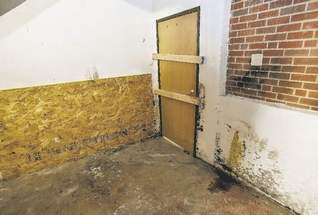
Boards block the entrance to a sewer-damaged area of the complex. City housing inspectors said last month that they planned to condemn the property unless repairs were made.

By DONNELLE ELLER
October 19, 2009

Melissa Sholley says the low-income apartment complex on Des Moines’ south side “just sucks the life out of you.”

She says loitering visitors usually mean a drug deal is in the works. Tenants’ pets urinate on the stairs and hallways. Mold in the basement has caused her headaches. “It’s not somewhere I want him to be,” nodding to her 2-year-old son, Korbyn.

The troubled complex – marked for condemnation in September – has an unlikely owner, the Iowa Finance Authority. The state housing agency has more than $500,000 invested in the property and took possession a year ago from an out-of-state owner seeking to avoid foreclosure.

In a few weeks, Southern Meadows Apartments will be sold to another government, the city of Des Moines.. The project is part of the city’s plan to buy and rehabilitate or raze 90 foreclosed housing units.

The city plans to spend as much as $1.3 million of $3.9 million in federal neighborhood stabilization money to buy the 34-apartment complex and make it suitable for private development

Linda Westergaard, an east-side neighborhood leader, questions whether a third of the neighborhood recovery money should be sunk into one site.

“Foreclosures are affecting my neighborhood and neighborhoods across the city. Why put so much money in one project, when there are so many houses that need to be rescued?” said Westergaard, president of the Northeast Neighbors, a coalition of north and east Des Moines neighborhood associations.

Without the city’s intervention, the property at 2800 S.E. Eighth St. would not likely find a buyer, said Larry Hulse, Des Moines community development director. “It would negatively impact the surrounding neighborhood if it was boarded up and nothing happened with it.

“The property has been in distress for some time,” he said. “It’s about as bad as it gets.”

Developer owed state $570,000 on property

The city and state’s history on the property dates back to the mid-1990s.

In 1995, the city gave a development company, Indianola at Eighth, $101,592 in federal housing money to rehabilitate the building, but the group never completed construction. The city received $5,000 of the nearly $50,000 it was supposed to be repaid before the property fell into foreclosure.

The Iowa Housing Corp., a nonprofit group that disbanded and transferred its assets to Iowa Finance Authority in 2003, loaned the development group $150,000. And Iowa Finance Authority was into the project for $85,000.

The primary lender, West Bank, also provided the developer a $450,000 loan.

When West Bank sold the complex to Marvin Thomason of Southern Meadows Association in 2003, Iowa Finance agreed to give his company a consolidation loan of $603,000 to save the project as “affordable housing for very low-income tenants,” records show.

By August 2008, Thomason had stopped paying his Iowa Finance loan, owing the agency $570,000. The state agency then realized how far the building had deteriorated and decided it needed to push foreclosure.

The state says its role as a lender hasn’t required it to monitor upkeep of the property.

“We sought quicker action on foreclosure because of the building’s condition,” said Craig Johnson, an Iowa Finance loan underwriter. “The owner was collecting rents, but he wasn’t spending it fixing the building.”

Despite the groups’ efforts to help the property’s development, the building has “suffered from substandard rehabilitation work” and “problematic management” since the mid-1990s, the city said.

City will seek developer who might build condos

David Dunn, a Des Moines planner, said the city will have more control over the project as the owner.

The city plans to demolish the 1950s addition at Southern Meadows, the first floor of which is closed, contaminated with mold and sewage; gut the main building, constructed in 1921; and conduct needed archeological and environmental studies.

Then the city must find a developer. The most likely plan: build condos in the remaining historic space and construct townhouses along the edge of the three-acre lot. The condos and townhouses would most likely be sold to moderate-income families.

The proposal could eliminate many of the hurdles Iowa Finance Authority faced when it tried to sell the property.

No nonprofit housing groups would consider rehabilitating the apartment complex, Johnson said. The groups said the property repairs were too expensive to tackle.

In September, Des Moines housing inspectors told Iowa Finance it planned to condemn the property, unless major problems were remedied, including fixing a broken sewer line, said Ben Bishop, who leads the city’s inspection department. “It was unlivable,” he said. “It had serious mold issues in the basement where the plumbing had backed up. And sewage wasn’t going into a sewer line. That’s a problem.”

In September 2008, the city cited Iowa Finance Authority, in the process of taking over the property, for 243 health and safety violations. The state spent about $200,000 addressing immediate safety concerns.

Bishop said the building had a long history of violations but none as severe as those that surfaced a year ago. The state agency said it would close the building.

Citizen questions value of city’s investment

Westergaard, the east-side neighborhood leader, said she’s concerned about more taxpayer money going into the project.

“Does the city need more townhouses and condos?” she asked. “The city will never get its money back. Why not tear down the building and build a park?”

Mark White, who lives near Southern Meadows, said it makes sense to redevelop the property. It’s close to downtown and shopping and sits across from Howe Elementary School. “It’s a good spot for families,” he said.

Dunn, the Des Moines planner, said the city should see some of the money returned once the property is sold to a developer. But the neighborhood stabilization program is designed to help housing that’s unattractive to private buyers. “It’s a second chance for a viable property,” said Dunn.

Now the city and state are working to relocate the building’s remaining 20 residents, providing rental and moving assistance, said Shawna Lode, an Iowa Finance spokeswoman. “No one is going to be homeless because of this,” she said.

Altogether, the city has set aside about $300,000 of the federal recovery money to help relocate residents, including up to three years’ rent assistance to cover the added costs of renting similar housing. It’s a federal rule the city must meet, Dunn said.

So far, finding a new home that’s affordable has been a challenge, said Sholley, who lives with her son and husband, Joseph, in the complex. The couple’s rent was about $500 a month.

“I’ve got most everything packed,” she said earlier this month. “I’m happy to be leaving. And the deposit and first month’s rent help.”

Dunn sees the dilapidated building becoming a “landmark.” He said redevelopment of the site could begin in about a year.

desmoinesregister.com

Note – “Dunn sees the dilapidated building becoming a “landmark.”  – Are you kidding me!  Too bad this is not in Louisiana.  The State of Louisiana and the Louisiana Housing Finance Agency would have that complex up and running regardless of mold contamination just like Jefferson Lakes Apartments in Baton Rouge.  They just IGNORE inspection reports!  katy

Note – Information on Riverstone Residential knowingly exposing tenants to extreme amounts of mold toxins at Toxic Mold Infested Jefferson Lakes Apartments in Baton Rouge, Louisiana.  katy

Toxic Mold Infested Jefferson Lakes Apartments managed by Riverstone Residential
Riverstone Residential Litigation

Mold Inspection Reports

Photos of Mold in Apartment

Posted in Environmental Health Threats, Health - Medical - Science, Louisiana Housing Finance Agency, Mold and Politics, Toxic Mold | Tagged , , , , , , , , , , , , , , , , , , , , | Leave a comment

Tenant Troubles: Wet, Cold, & Moldy – San Francisco Appeal

mold

by Dave Crow
October 14, 2009

Just three days after the Appeal launched, commenter Generic said that a “How Not To Get F….. By Your Landlord” column would be “awesome.” And since that day I’ve been searching for the perfect person to write such a column — and found that in Dave Crow, a lawyer who specializes in SF tenants’ issues*. Dave’s here to answer your questions every Wednesday, so send them to him at tenant@sfappeal.com – EB

I live in the Panhandle area in a 6-unit building. My apartment building has some serious temperature and mold issues.

Our common entryway has a broken skylight that leaks every time it rains. The first floor rug is now discolored and smells of mold. The landlord insists he’s “done as best he can” to fix the leak.

All of the units’ bedroom closets have huge mold problems on the walls. The landlord’s best response is to just to keep bleaching the walls. Other areas of each apartment have mold the landlords only “solutions” are to cover the areas over with paint or tile.

The building’s steam heat works inconsistently. The timer doesn’t seem to be working correctly. The windows don’t seal properly or have chunks of wood missing from the base. When tenants complain of the cold, the landlord’s only response to this is to apply cheap foam weather stripping (that’s since fallen off) to the windows.

For what we pay, we shouldn’t have heat or mold issues. So my question is, besides putting our own money into the building, can we as tenants do anything to turn our building around and into shape?

Dear Wet, Cold and Moldy in the Panhandle,

As I write this, the first big storm of the season has begun. It’s time for you and your fellow tenants to get proactive. I get the sense that everyone in the building is fed up and that you might be able to work together as a team. That’s great. Remember, there is safety in numbers.

The landlord says he’s “done as best as he can.” What is he–a four-year-old at a Berkeley T-Ball tournament? Shall we give him a trophy just for showing up? This is the type of landlord I like to call a Cheese Ball, a cheap buffoon who thinks he can own an apartment building, take all the tax deductions, collect the outrageous rent and not spend a dime to maintain it. Oh, he’ll bitch and moan about rent control and whine about all the labor he’s expended, but you must understand that this Cheese Ball wouldn’t maintain his property if he could charge $10,000.00 a month per unit and he would never pay a professional to fix anything. I can go on and on, but maybe I should answer your questions.

The landlord is breaching the implied warranty of habitability in your lease. The landlord has the duty, even if it is not in the lease, to provide you with a “habitable” unit. California Civil Code §1941.1provides a long list of characteristics of a unit that make it “untenantable” or uninhabitable.

Roof leaks and the problems caused by them, i.e. mold, cracked paint, and of course, water dripping inside are usually clear and substantial breaches. (Civil Code §1941.1[a]) The problems you describe indicate a more general roof problem than just the skylight. While mold and mildew occur frequently in bathrooms without roof leaks, the closets are a tip-off to me.

Remember, you pay your rent in exchange for the landlord providing a service, nothing more or less.As a former housepainter I know that you cannot just paint over mold and mildew; it grows through the paint. And even if you kill the mold, it will return if the roof has not been adequately repaired.

Windows that rattle and leak air and, as you indicated in the unpublished part of your letter, sills that are rotted off are also violations of Civil Code 1941.1(a). Cheap foam insulation doesn’t count as repair.

Finally inadequate heat is a violation of Civil Code 1941.1(d). San Francisco Housing Code §701(c) also requires that a permanent heating source be provided that is capable of maintaining a temperature of at least 68 degrees Fahrenheit in all habitable rooms, excluding bathrooms and hallways. The Housing Code specifically requires this level of heat to be provided 13 hours a day, from 5 AM to 11 AM and also from 3 PM to 10 PM. See Rent Board Topic No. 257

All right, now you know that it’s likely the landlord violated the law. What do you do about it? Normally I would suggest you write your landlord a letter outlining all of the problems and asked him to fix them in a short period of time, preferably not before the next ice age. BTW, if you haven’t already done so, begin to communicate with the landlord only in writing. Even if he can’t read, he will understand that your relationship has changed.

But in this case, Mr. Cheese Ball has already been notified. He’s done his best. Make a list of everything that seems questionable, call a housing inspector from the SF Department of Building Inspection and arrange a time for the inspector to visit all six units and all the common areas. Show the inspector everything. If the roof is accessible, cajole them to go up there or refer to another inspector who will. Also check to see if the building has complaints or violation from the past.

The DBI will issue a notice of violation (NOV) for the various issues and require the landlord to repair them in thirty days. You now have good evidence to use when you file a petition at the Rent Board to reduce your rent due to a substantial decrease housing services or suing the landlord in superior court for breach of the warranty of habitability.

You and all of your fellow tenants at the building should join the San Francisco Tenants Union. They can provide more specific counseling based on the facts of your situation.

Remember, you pay your rent in exchange for the landlord providing a service, nothing more or less. If he gets pissed off because you make him do his job, it’s his problem. Don’t let him make it yours. Good luck.

sfappeal.com

Note – Information on Riverstone Residential knowingly exposing tenants to extreme amounts of mold toxins at Toxic Mold Infested Jefferson Lakes Apartments in Baton Rouge, Louisiana.  katy

Toxic Mold Infested Jefferson Lakes Apartments managed by Riverstone Residential

Riverstone Residential Litigation

Mold Inspection Reports

Photos of Mold in Apartment

 
Posted in Environmental Health Threats, Toxic Mold | Tagged , , , , , , , , , , , , , , , , | Leave a comment

Video – Enclave Apartments – Silver Spring, MD – Woman Says Moldy Apartment Put Her Out $8,000

10-16-09

SILVER SPRING, Md. – A local woman says she lost everything after mold started growing in her apartment.

Charmaine Green-Forde lives in the massive 1100-unit Enclave Apartments in Silver Spring, and says her apartment has made her sick.

“I noticed that when I wasn’t in the apartment I felt OK, but anytime I was in the apartment, I really wasn’t feeling well,” she said.

She also says she is not being treated fairly and is concerned 60 other tenants who also live there might be in a similar situation.

It all started after an older model AC unit backed up and flooded her apartment while she was out of town this summer. “There was so much water that the water was actually seeping under here and running off of the balcony,” she said.

Then she started having problems with headaches, nausea and sinus problems.

That, she said, launched a months-long battle with the apartment complex–a place she’s called home for two years.

First, she says, only the carpet padding was replaced, then the carpet itself. Then she says workers told her the bedroom wall was taken care of and that she wouldn’t have to worry about mold, but she didn’t buy it.

“I don’t see any breaks in the wall… the wall still felt wet… it’s just not good,” she said.

A few weeks later, mold began creeping across three bedroom walls. The county condemned the unit and the Enclave put Green-Forde up in this efficiency where she promptly found a patch of what looked like…mold.

In addition, Green-Forde had to continue paying rent. An email from the Enclave says no rent credits are offered for leaks.

In a written statement, the Enclave told ABC 7 News they “did not request the resident move back into her apartment before repairs were properly made.”

Meanwhile, an environmental company has just signed off on the condition of the apartment and Green-Forde can move back in when she’s ready.

A county judge just let her out of her lease and that she’s entitled to no more than $2,500 compensation. But she says between new clothing, housing and medical bills she’s out nearly $8,000.

click here to see video

Note – Information on Riverstone Residential knowingly exposing tenants to extreme amounts of mold toxins at Toxic Mold Infested Jefferson Lakes Apartments in Baton Rouge, Louisiana.  katy

Toxic Mold Infested Jefferson Lakes Apartments managed by Riverstone Residential

Riverstone Residential Litigation

Mold Inspection Reports

Photos of Mold in Apartment

 
Posted in Environmental Health Threats, Toxic Mold | Tagged , , , , , , , , , , , , , , , , , , | Leave a comment

How Intestinal Health & Integrity Is a Large Factor In Environmental & Many Illnesses

By Mark Hyman, MD
10/16/2009  

There might be something wrong with your inner tube, and it could be making you sick and fat.

You may not even realize you have a problem …but if you have health concerns of any kind or you are overweight, your inner tube could be the root cause.

Of course, I’m not talking about a beach toy. I mean the inner tube of life — your digestive system!

It is likely that you suffer from (or have suffered from) some type of digestive disorder — irritable bowel syndrome, bloating, constipation, diarrhea, heartburn, reflux, gas, and other things too gross to mention in print.

And you are not alone. More than 100 million Americans have digestive problems.

Two of the top five selling drugs in America are for digestive problems, and they cost us billions and billions of dollars.

There are more than 200 over-the-counter (OTC) remedies for digestive disorders, many of which can create additional digestive problems.

Visits for intestinal disorders are among the most common reasons for trips to primary care physicians.

And that’s not even the worst news.

Most of us (including most doctors) do not recognize or know that digestive problems wreak havoc in the entire body, leading to allergies, arthritis, autoimmune disease, rashes, acne, chronic fatigue, mood disorders, autism, dementia, cancer, and more.

So having a healthy gut means more than simply being free of annoyances like bloating or heartburn!  It is absolutely central to your health.  It is connected to EVERYTHING that happens in your body.

That’s why I almost always start helping people treat chronic health problems by fixing their gut, which is what I want to help you do today.

Today, you will learn how you can find out if you have a problem with your gut (though many of you won’t need me to tell you — your gut will speak for itself!), and I will give you 7 simple steps you can take today to heal your inner tube of life.

Fixing your digestion is the 4th key of the 7 Keys to UltraWellness or functional medicine, and it is absolutely essential that you heal this critical system in your body if you want to achieve optimum health.

Why your gut is so important? Let me explain …

How Your Gut Keeps You Healthy or Makes You Ill

The health of your gut determines what nutrients are absorbed and what toxins, allergens, and microbes are kept out. It is directly linked to the health of your whole body.

Intestinal health could be defined as the optimal digestion, absorption, and assimilation of food.  But that is a big job that depends on many other factors. Let’s look at a few of them …

First, there are bugs in your gut that form a diverse and interdependent ecosystem like a rainforest. In fact, there are 500 species and 3 pounds of bacteria in your gut which form a HUGE chemical factory that helps you digest your food, regulate hormones, excrete toxins, and produce vitamins and other healing compounds that keep your gut and your body healthy.

This ecosystem of friendly bacteria must be in balance for you to be healthy.

Too many of the wrong bacteria, like parasites and yeasts, or not enough of the good ones, like Lactobacillus or Bifidobacteria, can seriously damage your health.

So keeping a healthy balance of bugs in your intestines is one factor to good gut health.

Second, there is your gut-immune system. Your entire immune system — and the rest of your body — is protected from the toxic environment in your gut by a lining that is only ONE cell-thick layer. If spread out, this lining would take up a surface area the size of a tennis court, and the entire thing is covered by a sewer!

If that barrier is damaged, you can become allergic to foods you may normally be able to digest perfectly well, you will get sick, your immune system will become overactive, and it will begin producing inflammation throughout your body.

Filtering out the good molecules from the bad molecules and protecting your immune system is yet another important factor in gut health.

Third, there is your second brain — your gut’s nervous system. Did you know your gut, actually contains MORE neurotransmitters than your brain? In fact, the gut has a brain of its own. It is called the “enteric nervous system” and it is a very sophisticated piece of your biology that is wired to your brain in intricate ways.

Messages constantly travel back and forth between your gut-brain and your head-brain, and when those messages are interfered with in any way your health will suffer.

Fourth, your gut also has to get rid of all the toxins produced as byproducts of your metabolism, which your liver dumps into bile. If things get backed up when you are constipated, you will become toxic and your health will suffer.

And last but not least, your gut must break down all the food you eat into its individual components, separate out the vitamins and minerals, and shuttle everything across the one cell-thick layer mentioned above so it can get into your bloodstream and nourish your body and brain.

Your gut has quite a lot to manage. Even in perfect world it is hard to keep all of this in balance.  But in our modern world there are endless insults that can knock our digestive systems off balance; it is that much more difficult to maintain excellent digestive health.

How to Know if Your Gut is Out of Balance

To fix your digestion, you first need to understand what is sending your gut out of balance in the first place. The list is short:

  • · Our low-fiber, high-sugar, processed, nutrient-poor, high-calorie diet, which causes all the wrong bacteria and yeast to grow in our gut and damages the delicate ecosystem in your intestines.
  • · Overuse of medications that damage the gut or block normal digestive function –things like acid blockers (Prilosec, Nexium, etc.), ant-inflammatory medication (aspirin, Advil and Aleve), overuse of antibiotics, steroids and hormones
  • · Undetected gluten intolerance, celiac disease or low grade food allergies to foods such as dairy, eggs, or corn.
  • · Chronic low-grade infections or gut imbalances with overgrowth of bacteria in the small intestine, yeast overgrowth, parasites, or even more serious gut infections
  • · Toxins like mercury and mold toxins, which damage the gut
  • · Lack of adequate digestive enzyme function, which can come from acid-blocking medication use, or zinc deficiency
  • · Stress, which can alter the gut nervous system, cause a leaky gut, and change the normal bacteria in the gut

What happens then is obvious. You get sick.

But what’s important to understand is that many diseases that seem to be totally unrelated to the gut — such as eczema or psoriasis or arthritis — are actually CAUSED by gut problems. By focusing on the gut, you can get better. Here is an example …

Can Eczema Start in the Gut?

Allison, one of my patients who suffered from eczema — a weepy, red, oozing, scaly, itchy rash — all over her body is perfect example of what can happen when your gut is out of balance and the extraordinary level of healing that can occur when you fix your digestion.

This woman, who saw doctor after doctor, put salves, lotions, and potions on her skin and gave her steroids and antibiotics. But none of them ever addressed the underlying cause of her problem.

Allison was 57 years old and had been suffering from severe, unrelenting eczema for eight years.  She ate a high-sugar diet and had a history of frequent vaginal yeast infections.

When I saw her, I checked her gut and found she had a leaky gut — that one-cell thick lining in her intestines was breached and wasn’t working properly. She had developed 24 IgG food allergies, and her stool had no healthy bacteria and an overgrowth of yeast from years of taking antibiotics.  She also had very high blood levels of antibodies against yeast.

So I helped her heal her gut. I asked her to stop eating the foods she reacted to, told her to stop feeding the yeast in her gastrointestinal tract by cutting out sugar and refined carbohydrates (which they thrive on), and killed the yeast in her gut with antifungal medications and herbs.  Then I helped her rebuild her ecosystem of healthy bacteria with probiotics and provided here with healing gut nutrients that allowed her intestinal lining to resume its normal function.

The result?

Her eczema disappeared for the first time in eight years — and it stayed away!

You can experience the same thing Allison did. You may be able to heal from many of your chronic symptoms simply by fixing your digestion. Here is how you do it.

7 Steps to Optimal Digestive Health

To heal your inner tube of life you simply need to:

  1. Eat whole unprocessed foods. Make sure to include plenty of fiber from foods like vegetables, beans, nuts, seeds, and whole grains.
  2. Eliminate food allergies.  If you think you have food sensitivities, try an elimination diet. Cut out gluten, dairy, yeast, corn, soy, and eggs for a week or two and see how your gut feels and what happens to your other symptoms.
  3. Treat any infections or overgrowth of bugs — Parasites, small bowel bacteria, and yeasts can all inhibit proper gut function. You must treat these infections if you want to heal.
  4. Replenish your digestive enzymes. When you don’t have enough digestive enzymes in your gut, you can’t properly covert the foods you eat into the raw materials necessary to run your body and brain. Take broad-spectrum digestive enzymes with your food to solve the problem. 
  5. Rebuild your rain forest of friendly bacteria. Take probiotic supplements. They will help you rebuild the healthy bacteria so essential to good gut health.
  6. Get good fat. Take extra omega-3 supplements, which help cool inflammation in the gut.
  7. Heal your gut lining. Use gut-healing nutrients such as glutamine and zinc to repair the lining in your gut so it can resume its normal function.

Fixing your digestion may take some time, but it can be done. And it is absolutely essential if you want to achieve vibrant health.  So work on your inner tube of life using the steps above and watch as your symptoms (and those extra pounds) disappear. 

References

·        Hunter JO. Food allergy–or enterometabolic disorder? Lancet. 1991 Aug 24;338(8765):495-6.

 ·        King DS. Can allergic exposure provoke psychological symptoms? A double-blind test. Biol Psychiatry. 1981 Jan;16(1):3-19.

 ·        Ludvigsson JF, Reutfors J, Osby U, Ekbom A, Montgomery SM. Coeliac disease and risk of mood disorders–a general population-based cohort study. J Affect Disord. 2007 Apr;99(1-3):117-26. Epub 2006 Oct 6.

·        Hu WT, Murray JA, Greenaway MC, Parisi JE, Josephs KA. Cognitive impairment and celiac disease. Arch Neurol. 2006 Oct;63(10):1440-6.

·        Wilders-Truschnig M, Mangge H, Lieners C, Gruber HJ, Mayer C, März W. IgG Antibodies Against Food Antigens are Correlated with Inflammation and Intima Media Thickness in Obese Juveniles. Exp Clin Endocrinol Diabetes. 2007 Dec 10

·        Thomas T. MacDonald and Giovanni Monteleone Immunity, Inflammation, and Allergy in the Gut, Science 25 March 2005 307: 1920-1925

·        Atkinson W, Sheldon TA, Shaath N, Whorwell PJ. Food elimination based on IgG antibodies in irritable bowel syndrome: a randomised controlled trial. Gut. 2004 Oct;53(10):1459-64.

·        http://digestive.niddk.nih.gov/statistics/statistics.htm

·        Benarroch EE. Enteric nervous system: functional organization and neurologic implications. Neurology. 2007 Nov 13;69(20):1953-7. Review.

·        Sandler RH, Bolte ER, Chez MG, Schrift MJ. Relief of psychiatric symptoms in a patient with Crohn’s disease after metronidazole therapy. Clin Infect Dis. 2000 Jan;30(1):213-4.

·        Lin, H. Small Intestinal Bacterial Overgrowth: A Framework for Understanding Irritable Bowel Syndrome JAMA. 2004 292: 852-858

·        Pimentel M, Park S, Mirocha J, Kane SV, Kong Y. The effect of a nonabsorbed oral antibiotic (rifaximin) on the symptoms of the irritable bowel syndrome: a randomized trial. Ann Intern Med. 2006 Oct 17;145(8):557-63.

·        Av SP. Hepatic encephalopathy: pathophysiology and advances in therapy. Trop Gastroenterol. 2007 Jan-Mar;28(1):4-10. Review.

·        Jansson-Nettelbladt E, Meurling S, Petrini B, Sjölin J. Endogenous ethanol fermentation in a child with short bowel syndrome. Acta Paediatr. 2006 Apr;95(4):502-4

·        Sandler RH, Finegold SM, Bolte ER, Buchanan CP, Maxwell AP, Väisänen ML, Nelson MN, Wexler HM. Short-term benefit from oral vancomycin treatment of regressive-onset autism. J Child Neurol. 2000 Jul;15(7):429-35.

·        Parracho HM, Bingham MO, Gibson GR, McCartney AL. Differences between the gut microflora of children with autistic spectrum disorders and that of healthy children. J Med Microbiol. 2005 Oct;54(Pt 10):987-91.

·        Wakefield AJ, Puleston JM, Montgomery SM, Anthony A, O’Leary JJ, Murch SH. Review article: the concept of entero-colonic encephalopathy, autism and opioid receptor ligands. Aliment Pharmacol Ther. 2002 Apr;16(4):663-74.

·        Aytac U, Dang NH.CD26/dipeptidyl peptidase IV: a regulator of immune function and a potential molecular target for therapy. Curr Drug Targets Immune Endocr Metabol Disord. 2004 Mar;4(1):11-8. Review.

·        Mentlein R. Dipeptidyl-peptidase IV (CD26)–role in the inactivation of regulatory peptides. Regul Pept. 1999 Nov 30;85(1):9-24. Review.

·        Ek J, Stensrud M, Reichelt KL. Gluten-free diet decreases urinary peptide levels in children with celiac disease. J Pediatr Gastroenterol Nutr. 1999 Sep;29(3):282-5.

·        Liu Y, Heiberg T, Reichelt KL. Towards a possible aetiology for depressions? Behav Brain Funct. 2007 Sep 14;3:47.

·        Wakefield AJ, Ashwood P, Limb K, Anthony A. The significance of ileo-colonic lymphoid nodular hyperplasia in children with autistic spectrum disorder. Eur J Gastroenterol Hepatol. 2005 Aug;17(8):827-36.

·        Uhlmann V, Martin CM, Sheils O, Pilkington L, Silva I, Killalea A, Murch SB, Walker-Smith J, Thomson M, Wakefield AJ, O’Leary JJ.Potential viral pathogenic mechanism for new variant inflammatory bowel disease. Mol Pathol. 2002 Apr;55(2):84-90.

·        Kawashima H, Mori T, Kashiwagi Y, Takekuma K, Hoshika A, Wakefield A. Detection and sequencing of measles virus from peripheral mononuclear cells from patients with inflammatory bowel disease and autism. Dig Dis Sci. 2000 Apr;45(4):723-9

·        Millward C, Ferriter M, Calver S, Connell-Jones G. Gluten- and casein-free diets for autistic spectrum disorder. Cochrane Database Syst Rev. 2004;(2):CD003498. Review.

·        Hu WT, Murray JA, Greenaway MC, Parisi JE, Josephs KA. Cognitive impairment and celiac disease. Arch Neurol. 2006 Oct;63(10):1440-6.

·        Kalaydjian AE, Eaton W, Cascella N, Fasano A. The gluten connection: the association between schizophrenia and celiac disease. Acta Psychiatr Scand. 2006 Feb;113(2):82-90. Review.

·        http://gut.bmjjournals.com/cgi/content/abstract/53/10/1459 (Food elimination based on IgG antibodies in irritable bowel syndrome: a randomised controlled trial)

·        Nicholas Shaheen; David F. Ransohoff Gastroesophageal Reflux, Barrett Esophagus, and Esophageal Cancer: SciIs Your Inner Tube Making You Sick?entific Review. JAMA. Apr 2002; 287: 1972 – 1981.

·        http://en.wikipedia.org/wiki/List_of_top_selling_drugs

·        Ruscin JM, Page RL 2nd, Valuck RJ. Vitamin B(12) deficiency associated with histamine(2)-receptor antagonists and a proton-pump inhibitor. Ann Pharmacother. 2002 May;36(5):812-6.

·        Dial S, Delaney JAC, Barkun AN, Suissa S. Use of Gastric Acid-Suppressive Agents and the Risk of Community Acquired Clostrium difficile-Associated Disease. JAMA. 2005 294(23): 2989-2995. Is Your Inner Tube Making You Sick?

healthiertalk.com

Toxic Indoor Mold Central

Posted in Environmental Health Threats, Health - Medical - Science | Tagged , , , , , | 1 Comment

Congressional Research Service – Toxic Mold: Insurance and Legal Issues

Note – The government legislation that never happened due to influence from insurance, real estate, construction, etc. industries.  And to hell with everyone’s health.   

Abstract

Emphasizing insurance issues, this report provides a summary of perceived perils, legal issues, and legislation associated with toxic mold.

Excerpt –

Risks to Health and Property

Mold can cause health problems and property damage.  First, while the most common molds are harmless to humans, mold can cause a variety of ailments. Some molds can produce allergic reactions, and others, which are far less common, but are hardly rare, can produce toxic effects and infections.  Symptoms associated with allergic reactions to mold include aggravation of asthma, a runny nose, congestion, cough, and eye irritation.  Molds that release mycotoxins in the air, such as the Stachybotrys chartarum strain, must reach toxic levels before illness occurs, but when they do, they can cause fatigue, headaches, nausea, asthma, and the inability to concentrate.  In the most serious, but scientifically uncertain cases, toxic molds allegedly can cause immune system disorders, chronic fatigue, organ damage, memory loss, and bleeding in the lungs.

Second, mold can cause property damage.  Residential and work environments provide three conditions for mold to thrive:

(1) warmth (40º to 100º F)

(2) moisture, often resulting from leaky roofs, defective plumbing, drainage problems, flooding, and even high-humidity

(3) nutrition, such as certain types of insulation, wood, and carpeting

Modern energy-efficient buildings provide a conducive environment for mold growth: Sealed construction techniques can result in insufficient flows of fresh air and reduced evaporation of moisture, creating warm, moist breeding grounds.  Older buildings also are not immune from mold contamination, particularly in areas subject to flooding, heavy storms, or high humidity.  Remediation costs vary with the scope of mold growth in these structures.  Inspection costs alone can range from the low thousands to millions of dollars.  In the most extreme cases, the buildings cannot be repaired, but must be stripped to their foundations and rebuilt at a price exceeding the original building costs.

PDF – Toxic Mold: Insurance and Legal Issues 

Note – Information on Riverstone Residential knowingly exposing tenants to extreme amounts of mold toxins at Toxic Mold Infested Jefferson Lakes Apartments in Baton Rouge, Louisiana.  katy

Toxic Mold Infested Jefferson Lakes Apartments managed by Riverstone Residential

Riverstone Residential Litigation

Mold Inspection Reports

Photos of Mold in Apartment

 
Posted in Environmental Health Threats, Health - Medical - Science, Mold and Politics, Mold Litigation, Toxic Mold | Tagged , , , , , , , , , , , , , , , , , , , , , | Leave a comment