Allegheny County inspection teams assess Baldwin housing units – Leland Point Acquisitions, Leland Point Holdings and Karam Managed Properties charged with with creating a public nuisance

National Apartment Association Tells Its Members MOLD CAUSES DEATH; Tells Courts It Doesn’t With The Help of US Chamber and UCLA

Thank You National Apartment Association. I will do my best to get this very important information out ASAP to numerous owners, investors, huge property management companies (e.g., Riverstone Residential), attorneys, and judges, AND, of course, to the MANY people who are currently living in MOLD-INFESTED APARTMENT COMPLEXES right now! katy

“All of the changes seem to be really positive,” McCoy said. “Everyone I’ve talked to is happy about it and a little amazed that the DA noticed and cared enough and bothered enough to actually do something about it.”

By Marie Wilson
PITTSBURGH TRIBUNE-REVIEW
Monday, June 28, 2010

Anne McCoy loves the layout of her apartment in the Leland Point complex in Baldwin Borough.

But when inspectors visited her Wednesday, she showed them everything she doesn’t love: a leaking kitchen faucet, damage to wooden cabinets and the mold, mildew and leaking pipes in the basement laundry and storage areas.

“Most of the lights in the parking lot had burned out, which is not good from a crime standpoint,” said McCoy, 49, who has lived in the 1,076-unit complex since August 2008.

Apartment inspections, increased police presence and a traffic study began after the Allegheny County District Attorney’s Office on June 3 charged Leland Point Acquisitions, Leland Point Holdings and Karam Managed Properties, the three Ohio-based companies that own the complex, with creating a public nuisance. On June 16, a judge appointed Brandywine Agency in North Versailles to oversee the complex.

Three teams of inspectors from the Allegheny County District Attorney’s Office and Brandywine began touring each apartment last week to determine how many repairs must be made to ensure sanitary and safe living conditions.

“It’s a criminal case, so we’re trying to gather evidence,” said Mike Manko, spokesman for the District Attorney’s Office. “That’s why we’re out there.”

Officials said the highest priorities are fixing clogged drains, broken hot water tanks and leaking sanitary pipes along with restoring natural-gas service to all tenants who were shut off because the companies failed to pay for it as part of the tenants’ rent.

“I have noticed more maintenance people here,” said Jody Grayson, 36, whose three-bedroom apartment was inspected Thursday.

Baldwin Police Chief Michael Scott said his department is working with Brandywine and the DA’s office to foster a safer atmosphere at the complex, where he said about 80 percent of the crimes in Baldwin occur.

“We’ve already started to see some improvements up there as far as the criminal element knowing it’s not a safe haven,” Scott said.

A plan to install two security cameras at each of the complex’s three main entrances and make some streets one-way could deter criminal activity, Scott said. The cameras are expected to cost about $21,000. Manko said the three ownership companies should pay for them as part of court proceedings to clean up the public nuisance.

Residents can learn more about the proposed cameras and traffic changes at a meeting scheduled for 7 p.m. Thursday in the Leland Point community room.

“All of the changes seem to be really positive,” McCoy said. “Everyone I’ve talked to is happy about it and a little amazed that the DA noticed and cared enough and bothered enough to actually do something about it.”

Rent payments that could have supported maintenance instead went to the property’s mortgage holder, Manko said, causing problems such as leaking pipes and broken screens to go unfixed. Other companies then refused to maintain the grass and landscaping because they were not being paid. The ownership companies owe the borough $575,325 for sewer service as of June 1, borough Manager Tim Little said.

Brandywine is the only company involved in renovations and safety improvements, said John Eddy, a Downtown lawyer representing Leland Point’s owners. Brandywine representatives did not return calls for comment.

The ownership companies might regain involvement after the court rules the nuisance is fixed, Eddy said.

“My client is most concerned about making sure the court is satisfied that the improvements are being made,” he said.

pittsburghlive

TRUTH OUT Sharon Kramer Letter To Andrew Saxon MOLD ISSUE

National Apartment Association Tells Its Members MOLD CAUSES DEATH; Tells Courts It Doesn’t With The Help of US Chamber and UCLA

FEMA Using US Chamber Fraud in Katrina Trailer Litigation; EPA, GAO & Both Isle$ of Congre$$ Turn Blind Eye$

New Action Committee – ACHEMMIC- Urges Transparency in EPA Policy Over Mold & Microbial Contaminants

Truth About Mold – the most up to date, accurate, and reliable information on Toxic Mold

Sociological Issues Relating to Mold: The Mold Wars

Political Action Committee – National Apartment Association (NAA) files Amicus Brief in mold case (two infant deaths in mold filled apt – Wasatch Prop Mgmt) citing US Chamber/ACOEM ‘litigation defense report’ to disclaim health effects of indoor mold & limit financial risk for industry

“Changes in construction methods have caused US buildings to become perfect petri dishes for mold and bacteria to flourish when water is added. Instead of warning the public and teaching physicians that the buildings were causing illness; in 2003 the US Chamber of Commerce Institute for Legal Reform, a think-tank, and a workers comp physician trade organization mass marketed an unscientific nonsequitor to the courts to disclaim the adverse health effects to stave off liability for financial stakeholders of moldy buildings. Although publicly exposed many times over the years, the deceit lingers in US courts to this very day.” Sharon Noonan Kramer
Information about Riverstone Residential, the Louisiana Housing Finance Agency, and the owners of Jefferson Lakes Apartments in Baton Rouge, Louisiana allowing tenants to be exposed to extreme amounts of toxins from molds by intentionally concealing evidence

Irrefutable evidence indicates that Riverstone Residential, Guarantee Service Team of Professionals, & plaintiffs’ attorney, J Arthur Smith III, must have agreed to exclude evidence that would have shown the owners of Jefferson Lakes Apartments & Riverstone Residential had knowledge of the severe MOLD INFESTATION at the complex before we moved in

Riverstone Residential Litigation

Mold Inspection Reports

Photos of Mold in Apartment

Attorney Malpractice

Posted in Environmental Health Threats, Toxic Mold | Tagged , , , , , , , , , | Leave a comment

California Notified of Gulf Evacuation Plans – Fellowship of the Minds

California Notified of Gulf Evacuation Plans | Fellowship of the Minds

Posted in BP Oil Spill Info - TRUTH, Environmental Health Threats, Health - Medical - Science, Politics | Tagged , , , , , , | Leave a comment

EPA opening public “Decontamination Stations”; 400 people seek medical care after visiting Florida beach | Florida Oil Spill Law

EPA opening public “Decontamination Stations”; 400 people seek medical care after visiting Florida beach | Florida Oil Spill Law

Posted in BP Oil Spill Info - TRUTH, Environmental Health Threats, Health - Medical - Science, Politics | Tagged , , , , , , , | Leave a comment

G4: Corexit/oil eats through boat hulls, kidneys (PHOTOS/VIDEO) | Florida Oil Spill Law

G4: Corexit/oil eats through boat hulls, kidneys (PHOTOS/VIDEO) | Florida Oil Spill Law

Posted in BP Oil Spill Info - TRUTH, Environmental Health Threats, Health - Medical - Science, Politics | Tagged , , , , , , , | Leave a comment

The unseen disaster – Oil spill’s damage to the world beneath the waves is likely to be enormous and long-lasting

By Paul Montagna and Larry McKinney
Saturday, June 26, 2010

Paul Montagna holds the Endowed Chair for Ecosystems Studies and Modeling at the Harte Research Institute for Gulf of Mexico Studies, Texas A&M University-Corpus Christi. He’s written or contributed to more than 150 articles and reports on marine science.

Larry McKinney is executive director of the Harte Research Institute and chairman of the Gulf Alliance Ecosystem Assessment and Integration Committee. He’s worked with state and federal agencies on Gulf issues and has written numerous articles on Texas conservation

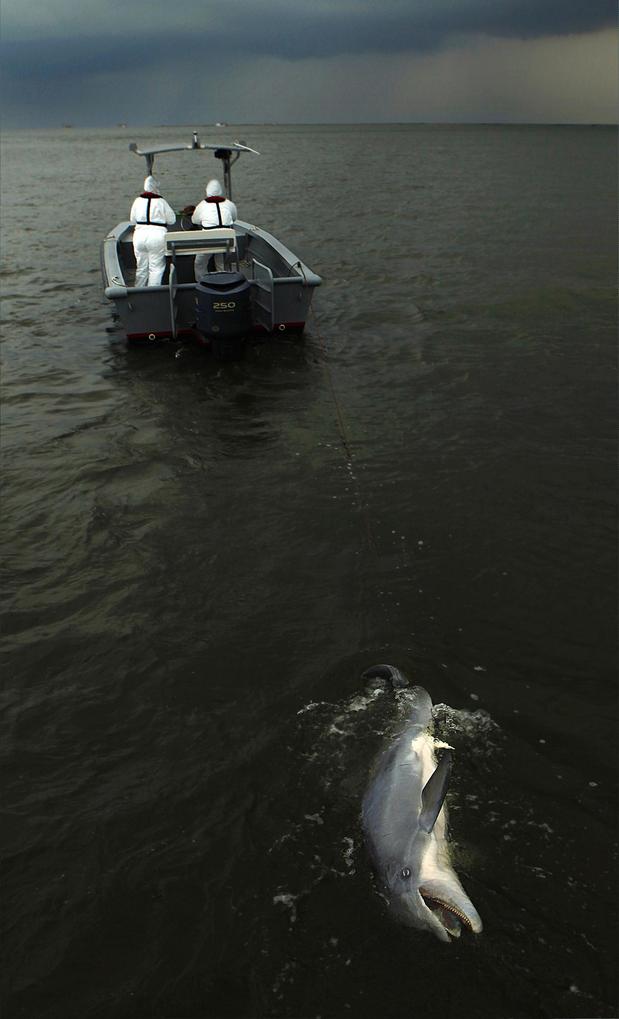
Biologists from the Louisiana Department of Wildlife and Fisheries recovered a dead dolphin off of Grand Isle, La., on May 29. The dolphin was to be taken for testing to see whether its death was the result of exposure to toxins from the Gulf of Mexico oil spill.

While much attention has focused on the pictures of oiled birds, marshes and beaches, the media is showing only the tip of the iceberg of the ecological disaster unfolding in the Gulf of Mexico. What is the condition of the ocean itself? The likely answer is: not good.

Scientists at sea and sampling the ocean on the scene of the oil well blowout are reporting plumes of oil throughout the water column for tens of miles from the blowout site. Dead organisms are covering the surface near the blowout. A dead sperm whale has been found far from shore.

To make matters worse, the area of the blowout and oil slick is the most productive part of the Gulf. This is because nutrients from the Mississippi River promote algal growth, which is at the base of the food chain. This plankton falls to the bottom, creating the richest shrimping and fishing grounds in the Gulf.

There are two problems caused by the spill. Not only are these organisms being killed, but the breakdown of the oil by bacteria consumes oxygen. That will further increase the size of the dead zone — a low-oxygen area devoid of sea life that has existed for years — off Louisiana this summer.

Extraordinary quantities of methane are contributing to this problem. Underwater clouds of oil and methane gas have now been confirmed as originating from the BP blowout after weeks of denial. One of these clouds, encompassing an area the size of San Francisco and 600 feet thick, was found at 3,000 feet or more beneath the surface. Low levels of oil concentration (0.5 parts per million) have been found in this cloud. Researchers studying the clouds have found concentrations of methane up to 10,000 times greater than normal and oxygen levels depleted by 40 percent below normal.

This means organisms in the sea are suffocating and explains why microbes that require oxygen to break down the oil are not cleaning the spill naturally. Worse is that there are likely long-lived “dead zones” drifting through the Gulf and perhaps over deep-water ecosystems where recovery time can be centuries, or not at all. Other, larger clouds have been reported, and a large-scale and coordinated effort is searching for more.

Massive quantities of dispersants (1.28 million gallons by day 58 of the spill) are being used at both the wellhead (5,000 feet deep) and the surface of the ocean. Used effectively at the surface, dispersants can accelerate microbial activity and degradation of toxic elements of an oil spill. We have no idea about effectiveness or impact when used at such depth. It is, as has been stated, a giant experiment.

It is a difficult choice, and few would disagree that keeping oil out of the wetlands is a high priority. However, beneath the sea surface is a toxic soup of oil, methane and dispersants, which is also killing many sensitive parts of the ecosystem. Because this disaster is unfolding beneath the surface, it is occurring out of sight. Its effects are probably more devastating to the Gulf of Mexico and the sustainability of the Gulf economy than those we have already seen. These effects have been occurring since the beginning of the blowout, long before oil arrived on the shore.

As the oil emerges from the sea floor, it immediately disperses into droplets, much like liquid being pumped from a sprayer. These droplets, along with methane and possibly dispersants, form a plume that bends with the current, much like smoke rising from a smokestack on a windy day. As the oil rises, the entire water column becomes degraded. You have a toxic stew killing millions upon millions of marine organisms.

As the oil reaches the surface, waves mix it with water and air, forming a “mousse.” The lighter components evaporate. As the heavier components mix with sediment and particles in the water, they will form a tarlike substance that will sink. The net effect is an impact that reaches from the bottom to the surface of the ocean.

Light from the sun further breaks down the smaller oil molecules at the surface, and now the dissolved fractions of the oil can contain many toxic compounds that can be absorbed by phytoplankton (small one-cell plants) in a process called bioaccumulation. Zooplankton (small floating organisms) can take up oil compounds, and small fish can also absorb it through their gills.

The larger danger, however, is biomagnification through the food web. Though the concentration of the toxic compounds in the water is small, these compounds dissolve in fat and concentrate within organisms. Zooplankton eat many phytoplankton, and small forage fish eat many zooplankton. Thus the toxic chemicals quickly become concentrated in ever-increasing amounts as it passes up the food chain.

Luckily, fish, birds and marine mammals can metabolize the oil so it does not biomagnify in the highest levels of the food chain. There is a cost, however, because animals will have to divert energy from reproduction to detoxify the oil, and they will produce less offspring, creating long-term declines in populations.

Species like the Atlantic bluefin tuna , which congregate and spawn practically in the middle of the spill zone, are especially susceptible. We may have already lost an entire year of the population of this species, which spawns only in the Gulf. These magnificent giants are already under extreme pressure from overfishing, and this spill could certainly be the tipping point in a downward and nonrecoverable spiral.

While most deep-sea habitats are primarily muddy bottoms, the Gulf of Mexico is unusual in that it has very complex bottom topography that includes many reefs, hard banks and deep trenches called the Mississippi Canyon and the DeSoto Canyon. These features are home to very diverse marine organisms.

One important feature in the area off the Mississippi-Alabama continental shelf is the Pinnacles habitat. This area is like an underwater mountain range that supports deep-sea corals, crustaceans, mollusks, sea lilies and many bottom fish. As the heavy parts of the oil sink, it will endanger the bottom habitats by coating them with tar.

At the surface are the pelagic fish such as tuna, amberjack and ling , which will become tainted. Dolphins and whales are plentiful in this region and will be coated with oil as they bob to the surface to breathe air.

The large, long-term danger may be from the oil that is stranded on the bottom. The deep sea is about the same temperature as your refrigerator, so bacteria will not be able to break down the oil, and we can expect tar balls to emanate from this area for decades to come.

This also means that the disaster will continue for a decade or two as the oil within the environment continues to break down, dissolve and move back into the surface waters. Even though smaller amounts will be released in the future, it will still have population-level effects because the juvenile stages of all marine animals are much more sensitive to toxins than adults. The lost juveniles will have a ripple effect throughout marine populations because there will be fewer adults in future generations to reproduce and replenish the lost animals.

Unfortunately, this blowout is the perfect object lesson about an ecosystem and what it truly means — a community together with its environment, functioning as a unit. Out of sight does not mean no concern. There are nothing but bad choices in a situation like this. However, the fact you cannot see it does not mean sea life can just be ignored and sacrificed.

statesman.com

Posted in BP Oil Spill Info - TRUTH, Environmental Health Threats, Politics | Tagged , , , , , , , , , | Leave a comment