Did Davis Biotech Firm Expose Davis to Potentially Dangerous Pathogens?

This week’s Sacramento News and Review featured a story by Seth Sandronsky which outlined the plight of former Sacramento resident David Bell, who worked for a Davis biotech firm, AgraQuest.

According to the the News and Review article:

“Five months later, he came down with severe flu symptoms. His face and teeth grew numb. Breathing became difficult and he developed severe headaches. His nose bled and his sputum turned bloody.

Ten years, four sinus surgeries and numerous medical treatments later, Bell remains incapacitated by the illness, which he and his mother, Sandi Trend, of Citrus Heights, claim was caused by bacteria and fungi he was exposed to at AgraQuest.”

The Vanguard has been investigating this story for the last several months and is very concerned about the possibility that some of the microbes and bacteria that were used in this lab could have escaped into the Davis environment and exposed Davis residents to potentially lethal infections. One of the problems that David Bell faced was a broken Worker’s Compensation system. The main focus of the News and Review Article was the plight of David Bell and the problems in the Worker’s comp system.

Our concern however is also with the residents who live and work near 1105 Kennedy Place, in Davis, the original location of Agraquest. It is located near two school sites and surrounded by residential neighborhoods.

At this point in time, we would like a regulatory agency to explore the area around the lab and determine whether there are possible pathogens that would represent a health risk. One of the challenges we face however is uncertainty as to who holds regulatory authority over this issue. Efforts at this time are underway to determine who holds regulatory authority and how the possibility of a health threat can be investigated.

WHAT THE LAB CONTAINED AND THE OFFICIAL RESPONSE OF CAL-OSHA

According to the News and Review:

“AgraQuest was founded in 1995 by Pam Marrone, a respected entomologist who had specialized in agriculture and insects at biotech giant Monsanto. Bell was a semester away from earning a bachelor’s degree in biology from Sacramento State when he started at the company in 1998. According to the transcript from his first workers’ compensation hearing, Bell worked primarily on two biopesticide projects, Laginex and Serenade.

Laginex is the brand name of Lagenidium giganteum, a water mold (fungi), which infects and kills mosquitoes. In a series of experiments, Bell documented what happened in water with mosquito larvae and Laginex and how to lengthen the biopesticide’s shelf life.

Serenade is a biopesticide used to control insects on crops. Its active ingredients are the Bacillus subtilis bacteria, which AgraQuest first found in a Fresno peach orchard. Bell tested soil samples taken from locations worldwide, using a fermentation process to extract the bacteria. He and a co-worker filled 10-kilo bags of Serenade from a larger drum. Bell did not wear a respirator while loading the Serenade.”

At the March 18, 2008 Davis City Council meeting, the Davis City Council presented Pam Marrone with the 2007 Business and Economic Development award. According to the News and Review, “Marrone left AgraQuest in March 2006 to found Marrone Organic Innovations in Davis.”

Marrone declined to comment for the News and Review Story; however, in October 2002, they write:

“As recently as October 2002, Marronewrote that Serenade is “safe to workers and ground water,” in the industry journal Pesticide Outlook. At the workers’ compensation hearing, Denise Manker, AgraQuest’s vice president of global product development, testified that the company and its employees followed proper safety procedures and had tested its strain of Bacillus subtilis to ensure it did not contain a substance that causes allergic reactions. While noting that soil samples in the laboratory can be hazardous if handled incorrectly, she said it was highly unlikely that Bell had become infected by the Bacillus subtilis, since it’s not known to be harmful to humans.”

Doug Haney is an advocate for human and patient rights who specializes in mold and microbe exposure. He wrote a book entitled “Toxic Mold! Toxic Enemy!” In it, he argues that over the years many researchers and doctors have been skeptical about the possibility of micro fungi infection, however in recent years there is increasing evidence of the danger of such organisms.

David Bell visited the Mayo Clinic in Arizona and they discovered a whole range of possible infectious agents. Sandi Trend, Bell’s mother, was able to link many of the agents in the patents that AgraQuest was using to agents found in David Bell’s body over the course of the last decade.

“According to peer-reviewed articles in British medical journal The Lancet, and other sources, serious questions have been raised about the safety of Bacillus subtilis for humans and animals.

Tests conducted at the clinic determined Bell had histo yeast, a mold found in soil, in his blood serum. He had developed histoplasmosis, which according to the federal Centers for Disease Control and Prevention affects the lungs and other organs and can be fatal if not treated.”

Unfortunately, it does not appear that OSHA, the Occupational Safety and Health Administration is equipped to handle this sort of problem.

CAL-OSHA investigated AgraQuest and found three of its ventilator hoods did not meet state standards. However, this was unrelated to the problems that David Bell is suffering from.

One of the big problems was pointed out by esteemed Dr. Larry Rose, who was the last doctor that worked for CAL-OSHA. OSHA has increasingly relied upon industry doctors and more often they have simply looked at smaller technical problems. They simply do not have the expertise to examine and diagnose this sort of problem.

As Larry Rose pointed out during a video interview which also featured local Davis activists and author of “Death on the Job” Dan Berman:

“When you’re called in and a worker has possibly picked up a very serious infectious disease from the work process, you don’t just go in and measure a face velocity and give a tag. You’ve gotta do some… you know real investigation. Go over all the medical records and you’ve got to get the organism and submit it to the proper lab to determine it’s patogenicity. In other words, there’s a series of steps you would take because you’re not only trying to protect all the workers there now and future workers, but you also have to protect the community when you’re talking about an infectious disease, this is a serious public health matter. So looking at what OSHA did [and] I’m just astounded that they had that kind of very weak response, inappropriate response according to the law.”

THE THREAT TO DAVIS–BIOTECH LAB IN A RESIDENTIAL NEIGHBORHOOD

As Doug Haney pointed out to me early on in my examination of this potential problem, he would be much less concerned about the possible health implications for the surrounding community of Davis if he believed that the lab was properly contained from the outside environment. Instead both photographic evidence and testimony from David Bell lead us to the opposite conclusion.

“The 20,000 microbes that they boast had been discovered throughout the world… were not fully contained in a way that specialized laboratories would require. That means they were in drawers, that they were open at some point, and exposed employees to whatever they were, they were unanalyzed, they were not determined at any point as to whether they were dangerous or not dangerous. That type of thing tells me that the laboratory was not a well-kept laboratory. The other part of it is that the building was in a residential area rather than a specific area for laboratories over in the Davis area.”

The problem as Mr. Haney pointed out:

“[AgraQuest was] very soft in their application of training, in fact there was little or none that I know of that David [Bell] indicated. There were open suitcases of dirt or soil that had been brought in from foreign countries that were exposed in the laboratory. OSHA and other standards for laboratories indicate that you should not have any kind of drinks or foods associated in the actual work areas of laboratories, they have to be set aside, that wasn’t the case at AgraQuest.”
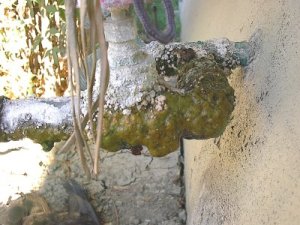
One of the biggest points of concern are photographs that show considerable corrosion on the outtake pipes several years after the lab moved from Kennedy Place to Drew Avenue. Is this residual pollution from the AgraQuest lab? Doug Haney believes so. As alarming was the fact that the dead crow in the picture above lay just beneath the pipe–undecomposed for two weeks between the time that the picture was taken and when Mr. Haney inspected the location.

“Ms. Trend had gone to that location about two weeks before I had a chance to view and told me about the fact there was this bird out there that was under this water outlet that showed a lot of corrosion, a lot of chemical build up. One thing about microbes, especially microfungi, is that they are the first to decompose in the external elements outside. This bird was not decomposed which told me that the company that produced the chemicals, Agraquest, were to destroy microfungi. And in this case, it kind of gave me the conclusion that those chemicals even six years after they had moved from the building were still strong enough and in the soil enough to eliminate rapid decomposure that rapidly takes place after an animal or person or a live species dies.”

It would be a fairly easy task to have an agency or the health department take soil samples from around this building and determine if this actually represents a threat to the health of Davis and whether or not AgraQuest was responsible for this contamination of the environment.

Another concern is accounts by David Bell that indicate the use of a type of drain as a place to dump chemical and possibly biological residues.

David Bell told the Vanguard by phone from his current residence in Texas:

“It was more like a concrete culvert that enters onto a lawn, I don’t think it actually goes into a sewer system. They chiseled out most of it already. It would kind of be like a big water runoff area, it was concrete and kind of sloped to the center, and that’s where the cleaning of everything took place.”

In the video that featured Dan Berman and Dr. Larry Rose, Sandi Trend, the mother of David Bell gave a full description of what occurred:

“David was instructed…. He was told to pick up this “drum” that was on an offsite farm because they wanted to use this drum for other broth, fermentation broth. So what he did is he went over to this farm and he brought it back and there was still liquid in it. So he didn’t really know what he was suppose to do so he was told to clean it out and dump it down the drain. What drain? Well outside the lab….. and I went up there after this because I was trying to visualize in my mind, he’s telling me that they mixed up powder in the bathroom and that the only ventilation was the bathroom fan, which is a normal household fan – ok. So I’m trying to visualize this and when I get there I’m going, “What drain”? And I wasn’t the only one that was there so there was somebody with me. It’s like “what drain” and “I don’t see a drain” and it’s like “Well I wonder if that’s what David’s talking about “? And what it was was it was like a storm drain, right outside the lab door that had just been hollowed out into the concrete and it led right into the dirt. So, when I called up David I go, “Is this the drain you’re talking about”? He says “yeah”. And excuse the expression… ok? I go “you dumped it out there”?! And he said, “that’s where we dumped everything”. I said, “what the hell did you do that for”? “That’s were we dumped everything Mom, that’s where I was told to dump everything”. So, right into the dirt.”

The Vanguard asked David Bell whether there were pathogens in the drums:

“There should have been by that point [live pathogens in the drum]. Everyone was arguing whether bacillus subtilus was pathogenic, however the fermentation process would get contaminated. If it sat that long there definitely could have been anything sitting in there. The fermentation process was still relatively rich in nutrients. So once it’s opened up to the air for the very first time things start in at that point.”

In addition to dumping drums in the ground, there was also loss of some of the specimens from the lab.

“We were losing mosquitos all the time until I came up with a system to hold them in a mason jar with a screen on it. We were actually losing mosquitoes that weren’t even endemic to our area in our area.”

What kind of mosquitoes I asked David Bell:

“In particular what we were releasing were the malaria mosquitoes. There was no way to keep them contained when I showed up there.”

He said he believed the number that were released was probably too small to allow them to reproduce, but nevertheless this is another example of the lax control standards at the original.

AgraQuest’s new location on Drew Street may in fact be much more secure and up to date in their practices. It is important to note that the OSHA violations occurred at the new Drew Street location rather than the original location on Kennedy Place. As far as anyone knows, OSHA never inspected the original lab on Kennedy Place.

Where does this leave Davis at this point? It is difficult to say. Someone needs to thoroughly examine the soil around Kennedy Place to determine whether or not the agents in the soil represent a health threat to the Davis community.

I asked Doug Haney how big a concern this was. He pointed out that scientists estimate there are roughly 1.5 million microfungi and other species that have not been discovered and we only know about perhaps 400,000 species. That means you have an area from a foreign country that has ben excavated, you have a lot of unknown factors here.

“When you excavate an area that has never been excavated before into a foreign country, you are bringing those microbes in a new area and what happens with microbes in order to survive, they either fight off or ward off other species, or they integrate with other species and hybrid the species which makes them far more dangerous. “

Moreover, these species can survive for long periods of time as spores or in dormant stages. The health implications are unknown but potentially very serious.

“You could possibly rise in say neurological diseases, a rise in lower birth rate, a rise in cancer, a rise in leukemia, a rise in serious diseases.”

These could show up almost immediately in some cases such as David Bell or they could could impact the population down the line. It could be 10 to 20 years before some of the implications of this are fully known.

Again, much of this is simply unknown because no responsible agency or regulatory agency has really investigated the matter. That is perhaps the most alarming aspect of all of this.

On October 1, 2007, Sandi Trend and Doug Haney met with District Attorney’s Office Investigator Dan Stroski. Mr. Stroski was immediately interested and alarmed, however, he informed them some time later that the Yolo County District Attorney’s office did not have the resources to do such an investigation.

The Vanguard will have a follow up article on this next Monday where we will examine the implications for how AgraQuest got these soil samples into the country and the potential threat that that represents.

—Doug Paul Davis reporting

Story – davisvanguard.blogspot.com

Note – This is the “undecomposed” bird I found in the fireplace of the mold infested apartment (Jefferson Lakes) leased to us by Riverstone Residential (mold they have been hiding for years and continue to do now).  I can’t help but think of it as the “canary” that died from the toxins produced by such large amounts of mold.  Maybe mold toxins also act as a preservative after death.  katy 

Posted in Environmental Health Threats, Mold Litigation, Riverstone Residential, Toxic Mold | Tagged , , , , , , , , , , , , , , , , | Leave a comment

Housing & Health – Financial Crisis Threatens Children’s Well-Being

Margo Candelaria, Sarah Oberlander and Maureen Black

The Baltimore Sun
October 24, 2008

The nation’s housing crisis is also a health crisis – especially for children. When families lose stable housing, children lose the bedrock that anchors them to schools, neighborhoods, medical services, child care and social services, often with serious consequences for their health.

As of today, the Housing Authority of Baltimore City is closing the waiting list for the Housing Choice Voucher Program -Section 8 – because it has enough applicants for the next 12 months. In other words, families who need stable housing have to wait at least a year before getting onto a waiting list.

A recent story about a Baltimore family illustrates how central housing is to children’s health, and why in any plan for financial recovery or economic stimulus, housing needs to be part of the discussion.

The Growth and Nutrition Clinic at the University of Maryland School of Medicine treats children who are severely underweight and therefore at risk for multiple health and developmental problems. At a recent visit, 6-year-old Brandi and her 7-year-old brother, Keonte, who are both severely underweight with long histories of poor growth, had each gained more than 2 pounds over two months – more than they had gained in the preceding year. The children radiated enthusiasm as they arrived wearing clean, neatly pressed school uniforms and sporting wide smiles.

What was the “treatment” that resulted in this success? Their move to Section 8 housing.

The children’s parents have been lost to the drug world, and their grandmother recently died of liver disease; they are in the care of their 65-year-old, disabled great-grandmother, Carolyn Beane. With few resources, the family moved twice in the past year, ultimately crowding into a friend’s house. They were discouraged by the long waiting list for housing. The children’s weight faltered, and the lack of basic resources, such as table and chairs, made it difficult to follow our recommendations, including eating together to model positive mealtime behaviors.

When their housing application was approved, the family moved to their own home in the Clifton Park area. The children were excited to each have their own rooms. The security of a home alleviated the stress and anxiety of the family’s near-homelessness and enabled Ms. Beane to attend to the details of daily life – establishing routines, making healthy family meals they could enjoy together around a table, and ensuring that the children were prepared for school each day. A safe, secure home led to emotional changes in the family, enabling them to build the daily mealtime routines that led to the children’s healthy weight gain and propelled them onto a positive growth trajectory.

Many families across America could tell similar stories. Data from the National Center on Family Homelessness and from the Children’s Sentinel Nutrition Assessment Program, a collaborative project of the University of Maryland School of Medicine and medical centers in five other states with data on more than 30,000 young children, have found that housing instability increases children’s risks for multiple health challenges. These include poor growth, asthma, ear infections, anxiety, depression and delayed development.

The foreclosure crisis is forcing thousands of families out of their homes. Each day in the United States, more than 200,000 children have no place to live. In Baltimore, more than 3,000 city residents are homeless, and thousands more are crowded into unstable housing. Families with children are one of the fastest-growing segments of the homeless population.

Rates of homelessness and housing instability are expected to increase as more families lose housing in today’s market and deepening recession.

Although closing the waiting list for the Housing Choice Voucher Program will make a bad situation worse, the shortage of vouchers themselves is the real problem. In this time of economic crisis, conversations should focus on including vouchers in the economic stimulus and bailout package to help families who have lost or are on the verge of losing their homes.

Facilitating secure housing for families is a critical step toward ensuring the health and development of our nation’s children. Healthy children learn in school, are proud of their successes and become healthy, productive adults. Is there any better investment we can make?

Margo Candelaria and Sarah Oberlander are postdoctoral fellows and Maureen Black ( mblack@peds.umaryland.edu) is a professor in the department of pediatrics at the University of Maryland School of Medicine.

Story – http://www.knowledgeplex.org/news/2555321.html

Posted in Health - Medical - Science, Politics | Tagged , , , , , | Leave a comment

New to the List | Notorious Landlords

Two more apartment complexes in WA make the notorious landlords list – one in Bellevue, WA  and another in Everett, WA

https://katysexposure.wordpress.com/notorious-landlords/

Posted in Riverstone Residential | Tagged , , | Leave a comment

Study finds mold may only be hazardous to government officials and their families

Note – The study of government official’s mold susceptiblity is fictitious. Other information including direct quotes are real.

By Sharon Kramer

Excerpts from the article –

As if government officials did not have enough to worry about in these days of allegations of rampant corruption, a new study finds they may be more susceptible to toxic mold exposure than their constituents.

While the average citizens of New Orleans are being encouraged to return to the city with little warning of potential health hazards from breathing mold and the toxins they produce, Governor Kathleen Blanco has been residing outside of the Governor’s mansion. The mansion has been undergoing an $800,000 renovation, $500,000 of which is for mold removal.

In 2003, Bryan Brown, who leads the consumer protection division for Kansas State Atty. Gen. Phill Kline, sued Kansas Republican Party Chairman Tim Shallenburger over the home Brown purchased from Shallenburger, which was reported to have mold. Brown said things started falling apart in the house and that his children became ill because of mold.

After a $5.6 million dollar renovation of the South Carolina Governors Mansion three years earlier, First Lady Jenny Sanford said stachybotrys was causing health problems with her family. Stachybotrys is a known toxin producing mold. According to Mike Sponhour, spokesman for the South Carolina State Budget and Control Board which oversees maintenance on the building, “We understand the concern the first lady has for the health of her family and children. We take that very seriously. We’re committed to doing everything we can to fix the problem and make sure it doesn’t happen again.?

North Carolina Governor Mike Easley and his family were forced to move from the governor’s mansion because of mold. This is the second time in four years that the 114 year old mansion has been invaded by mold. According to Secretary of Administration Gwynn Swinson, the governor and his family needed to clear out for health reasons.

Although the government officials study was massive in the number observed to have required extensive mold remediation for the protection of their families that average citizens did not, including George W. Bush and the Governor of Mississippi, it was inconclusive in establishing if these government positions made officials more susceptible to mold illnesses than their constituents, or if their positions might actually have served to benefit the health of they and their families.

Full article – http://www.mold-help.org/content/category/92/

The news about the mold in the Louisiana governor’s mansion came out a couple of days after I had spoken to an attorney about the mold in our apartment (which was showing up just 3 months after moving in) and if we could get out of the lease and get our deposits back because it was so horrible there. The attorney called me and asked if I had seen the news about the governor’s mansion on TV. We were on the phone when the story came on cable news again. Mold growth on the vents was being shown and I told the attorney the mold growth covering our air vents was much worse and that happened in just 3 months. This massive amount of mold infestation had been hidden over and over again (and still is) by Riverstone Residential with paint and too many documented air and dryer duct cleanings on a regular basis.

3 years later the same state government that saw the importance of remediating the governor’s mansion (mold in the HVAC system can cause serious health conditions) was involved in the sale of the complex I was in (Jefferson Lakes). A mold inspection report was done during that sale documenting visible mold growth and mold in the HVAC systems (I have a more detailed one for the apt. we were in). This was ignored probably for financial reasons (greed). The state and Riverstone Residential allow people to continue living there and allow more to move into these very toxic apartments. Better yet – the state will even give some families a section 8 voucher so they can better afford to be poisoned. We paid the full cost of the rent to be poisoned. katy

Posted in Environmental Health Threats, Mold Litigation, Riverstone Residential, Toxic Mold | Tagged , , , , , , , , , , , , , , , , , , | Leave a comment

World Health Organization – The Right to Healthy Indoor Air

Abstract

Indoor air quality is an important determinant of health and wellbeing. However, the control of indoor air quality is often inadequate, one reason being the poor articulation, appreciation and understanding of basic principles underlying policies and action related to indoor air quality. As a result, the general public is familiar neither with those principles nor with their associated rights.

A WHO Working Group was convened to agree on a set of statements on “The right to healthy indoor air”, derived fromfundamental principles in the fields of human rights, biomedical ethics and ecological sustainability.

This document presents the conclusions of the Working Group, informs individuals and groups responsible for healthy indoor air about their rights and obligations, and individuals by bringing those rights to their attention.

Keywords

– AIR POLLUTION

– INDOOR ENVIRONMENTAL POLICY

– HOUSING

– HUMAN RIGHTS

– ETHICS

– EUROPE

Background

Indoor air quality (IAQ) is an important determinant of population health and well being. People in modern societies spend most of their time in indoor spaces such as at home, work, school and in vehicles. Exposure to the hazardous airborne agents present in many indoor spaces causes adverse effects such as respiratory disease, allergy and irritation of the respiratory tract.Improperly or poorly ventilated combustion appliances pose a real risk of acute poisoning bycarbon monoxide. Indoor exposure to radon and environmental tobacco smoke increases the risk of lung cancer. Many chemicals encountered indoors cause adverse sensory effects, giving rise to a sense of discomfort and other symptoms.

The control of indoor air quality is often inadequate in spite of its significant role in determining health.

Tensions and conflicts often occur between individuals suffering from indoor air pollution and those whose actions negatively influence indoor air quality. Most exposure to indoor air occurs in private homes, where intervention by public regulation is often considered a violation of personal freedom. Furthermore, commercial interests have often delayed the implementation of indoor air pollution controls in spite of scientific evidence of the harmful impact of such pollution on health.

To a large extent, the inadequate quality of indoor air arises from a poor articulation, appreciation and understanding of the basic principles underlying the policies and actions related to indoor air quality. As a result, the general public is familiar neither with those principles nor with their associated rights.

A WHO Working Group was convened to agree on a set of statements on “The right to healthy indoor air”, derived from fundamental principles in the fields of human rights, biomedical ethics and ecological sustainability.

These statements inform the individuals and groups responsible for healthy indoor air about their rights and obligations, and empower the general public by makingpeople familiar with those rights. The statements were formulated at a meeting of the Working Group convened by the WHO European Centre for Environment and Health (WHO/ECEH), Bilthoven Division, in Bilthoven on 15–17 May 2000. The invited experts, who represented a wide range of specialties and countries, were recommended to WHO by contacts in governmental institutions and through expert groups involved in the assessment and maintenance of indoor air quality, bioethics and environmental ethics (list of participants in Annex 1). The Chairperson of the meeting was Dr Lars Mølhave and Dr Nadia Boschi acted as Rapporteur. Those invited received in advance of the meeting a background paper prepared by a small group convened by WHO/ECEH in November 1999.

The exact text of the principles recommended, and most of the text of the commentary was agreed at the meeting. A smaller editorial group worked on it directly after the meeting, and the entire text of this report was reviewed and accepted by all members of the Working Group within a few weeks following the meeting. The report summarizes the main conclusions and recommendations of the Working Group, and sets out the statements on The Right to Healthy Indoor Air.

Statements on the right to healthy indoor air – Introduction

Everyone has a right to healthy indoor air. It is the dual purpose of this document to:

1. Inform those who have an influence on public health about this right and of their obligations related to this right, and

2. empower the general public by making people familiar with this right.

The right to healthy indoor air applies across the world. While it is an individual responsibility to prevent air pollution indoors, decision-makers both inside and outside the public health sector have important additional tasks in this respect. In particular, the building and energy sectors have pertinent roles to play. Many factors influence indoor air quality, including the design, construction, equipment, operation and maintenance of buildings or other indoor spaces, as well as outdoor air quality and the occupants’ preferences or activities. All individual groups, whether private or public, associated with a building or other indoor space, bear responsibility for healthyindoor air and the protection of the health of its occupants.

Human rights are the rights of individuals that should apply to all people around the world, representing fundamental freedoms or needs that every state ought to recognize and protect. Specific human rights law is listed in several key documents; foremost of these is the Universal Declaration of Human Rights, which was drawn up to give more specific definition to the rights and freedoms referred to in the United Nations Charter. The Charter, the International Covenant on Civil and Political Rights and the International Covenant on Economic, Social and Cultural Rights constitute what is often called the “International Bill of Human Rights”. These humanrights apply globally, irrespective of gender, age, religion, economic status, national origin, ethnicity and the like.

Dissemination of knowledge of the principles that determine individual rights to healthy indoor air will help people to understand what values are being given priority in any specific context, be it at the home, office or government level of decision-making and/or policy formulation. At the same time, encouraging individual behaviour towards sustainability will also help to ensuresustainable indoor air quality.

The principles below derive from the fundamental principles in the fields of human rights, biomedical ethics and ecological sustainability, and focus on interactions among them.

Principles

Principle 1 – Under the principle of the human right to health, everyone has the right to breathe healthy indoor air.

Principle 2 – Under the principle of respect for autonomy (“self-determination”), everyone has the right to adequate information about potentially harmful exposures, and to be provided with effective means for controlling at least part of their indoor exposures.

Principle 3 – Under the principle of non-maleficence (“doing no harm”), no agent at a concentration that exposes any occupant to an unnecessary health risk should be introduced into indoor air.

Principle 4 – Under the principle of beneficence (“doing good”), all individuals, groups and organizations associated with a building, whether private, public, or governmental, bear responsibility to advocate or work for acceptable air qualityfor the occupants.

Principle 5 – Under the principle of social justice, the socioeconomic status of occupants should have no bearing on their access to healthy indoor air, but health status maydetermine special needs for some groups.

Principle 6 – Under the principle of accountability, all relevant organizations should establish explicit criteria for evaluating and assessing building air quality and its impact on the health of the population and on the environment.

Principle 7 – Under the precautionary principle, where there is a risk of harmful indoor air exposure, the presence of uncertainty shall not be used as a reason for postponing cost-effective measures to prevent such exposure.

Principle 8 – Under the “polluter pays” principle, the polluter is accountable for any harm to health and /or welfare resulting from unhealthy indoor air exposure(s). In addition, the polluter is responsible for mitigation and remediation.

Principle 9 – Under the principle of sustainability, health and environmental concerns cannot be separated, and the provision of healthy indoor air should not compromise global or local ecological integrity, or the rights of future generations.

Commentary

In this part of the document, the application of the above principles is placed into context and explained. The principles and the commentary are mutually supportive. It may happen that any of the principles could be in apparent conflict with others. It is the object of any rights – or ethics-based analysis to be transparent in the rationale as to how a decision to act was reached. Inproviding such a rationale, any principle could take precedence over any other. The articulation of the rationale for invoking any one principle over another establishes transparency.

Principle 1 – The human right to health

The severity of symptoms and the duration of any negative health effects are primary criteria for determining the seriousness and importance of various indoor air pollution health impacts. Shortened life expectancy, diminished quality of life, disability and hospitalization are key indicators. Symptoms of health effects resulting from indoor pollutant exposure can be classified by severity and duration. Short-term acute effects resulting from infectious agents are often affected by building practices.

Examples include –

Respiratory diseases such as legionnaires’ disease and hypersensitivity pneumonitis. Asthma and allergy, or chronic upper respiratory obstructive diseases may have less severe acute symptoms but are important because of their lengthy (often life-long) duration. The quality of indoor air not only has a bearing on health, but also on the quality of life.

This interpretation derives from the 1977 World Health Assembly, which resolved that by the year 2000, all people should attain a level of health permitting them to lead socially and economically productive lives. Exposure to pollutants that qualitatively decrease the health, functioning or comfort of occupants is, therefore, unacceptable. Indoor air pollution from the use of solid fuels in simple unvented stoves is common in developing countries. As their economies develop, populations tend to use cleaner fuels and less polluting stoves. That this occurs, however, does not imply that waiting for economic development is a necessary or desirable approach to achieving better indoor air quality. Indeed, the great triumphs in public health are in identifying ways to help people improve their health even before they participate in the fruits of economic development.

Principle 2 – Respect for autonomy (“self-determination”)

Everyone has the right to expect others to respect their individual judgement in their own evaluation of personal exposure and its effects. For example, if a person finds the air quality uncomfortable or offensive enough to warrant a formal comment or complaint, that person’s assessment needs to be respected.

Those responsible for public health and education have a duty to inform people regarding the relationship of indoor air quality to health. Article 26 of the United Nations Declaration on Human Rights states:

Article 26: (1) Everyone has the right to education…(2) Education shall be directed to the full development of the human personality and the strengthening of respect for human rights and fundamental freedoms. It follows from Article 26(1) that education programmes for the general population should underline the importance of indoor air quality for health and provide insight into the basic mechanisms and sources of pollutants.

It is essential that individuals have some level of personal control over their own indoor environment and air quality. The personal control is necessary because the evaluation of an “optimal indoor environment” differs from person to person. However, public health authorities should recommend minimum standards.

People have the right to adequate, understandable information about the environments that they inhabit. This includes balanced and objective information on the exposures and associated risks.

The right to self-determination requires that full information be available to people making decisions about actions affecting their indoor air exposure. Therefore, those with access to relevant information should make it available to others. The providers are accountable for the adequacy of the information they provide. The population should be protected against factors which may change their sensitivity to indoor air exposures as well as against misinformation causing people to set wrong priorities. All reasonable measures should be taken to inform the general public of national and international laws pertaining to indoor air quality, and their rights in relation to these laws.

Principle 3 – Non-maleficence (“do no harm”)

Indoor air should contain no pollutants without a justifiable reason or purpose for their presence.

It is recognized that a balance must be struck between indoor air requirements and considerations such as the economy and health.

Unwanted or unacceptable exposures are defined as the presence of indoor exposures that cause undesirable effects on the occupant(s).

Those who design, provide, build, maintain and occupy indoor environments have a duty to do no harm to indoor air quality in that environment.

Ignorance about indoor air quality matters is not an excuse for causing harm. The facts on indoor air quality must therefore be readilyavailable to, and used by, all the parties concerned.

Exposures indoors should not occur as the result of mitigation of environmental problems in occupational or outdoor environments (e.g. by discharge, dilution or substitution that migrates to the indoor environment).

Environmental tobacco smoke is a special case of an indoor air pollutant with serious, large-scale negative health consequences. As such, environmental tobacco smoke should be excluded from indoor environments.

Principle 4 – Beneficence (“doing good”)

Those who provide, maintain and occupy indoor environments have a responsibility to promote good indoor air quality. Protection of the health and comfort of the most sensitive occupants is required under the principle of beneficence.

When convincing evidence exists on health risks due to indoor air exposures, the appropriate societal authorities should organize or initiate action to prevent or eliminate these exposures.

Principle 5 – Social justice

Social justice refers to the equitable distribution of burdens and benefits within society.

Unhealthy indoor air is a burden, and healthy indoor air is a benefit. Therefore, there should be social and economic equity in the distribution of healthy indoor air. Those involved in public health should recognize this unequal distribution of healthy air by virtue of social or demographic factors. Special attention may need to be paid to affected groups, as well as to others vulnerable by virtue of their health status, to reduce health inequalities and ensure progress toward more egalitarian societies. Various groups experience different exposures to unhealthy indoor air, e.g. the economically disadvantaged (more exposure to environmental tobacco smoke, more poor quality combustion devices), women and the elderly (more time spent indoors), and ethnic minorities (lack of information in an appropriate language).

The right to quality indoor air is equally essential for people of all nations and at all socio-economic levels. Economically disadvantaged individuals must be given due consideration whenever decisions affecting their indoor air quality are to be made by either public or private organizations. All minorities (including susceptible groups such as children) have the same rights to protection as the general population. In particular, sensitive groups within the population have the right to adequate means for ensuring them an indoor air quality that meets their specific needs. Solidarity with the less privileged urges rectification of the unequal distribution of resources and prevention of and a response to human suffering.

Principle 6 – Accountability

As a minimum, all applicable laws and regulations should be followed. In addition, all relevant standards of practice and guidelines should be followed. Transparency provides the basis for understanding the rationale for decision-making.

Those responsible for and concerned with human and environmental health, both in governments and in nongovernmental organizations, should develop and adopt indicators of healthy indoor air and its achievement for the whole population. These indicators should include exposure and risk assessment related to indoor pollutants with significance for health. They should also include factors that have an impact on indoor air quality as well as determinants of general environmental quality that directly and indirectly affect and are affected by the quality of the built environment.

It is sometimes argued that household air pollution should not be the concern of government public health bodies. After all, it is said, the occupants themselves are responsible for most of the activities that produce the indoor air pollution they experience. Indoor air pollution, by this reasoning, is not an “externality” and thus does not need to be addressed by society at large. However, there are several problems with this argument.

• Governments and other outside agencies clearly do have a role in research and education to inform householders of the risks. Householders alone are not in a position to conduct or interpret such research.

• Through appliance standards, building codes, fuel standards and pricing, consumer product standards and labelling and other measures, governments already exercise a number ofcontrols over indoor air quality and have the responsibility to see that such controls reflect actual risks.

• Households are not democracies with every person having an equal say. Children, in particular, are not in a position to make the kind of judgment needed to protect themselves. In many societies, women have little say in many household economic decisions, such as the purchase of fuel, even though they may experience most of the indoor air pollution exposure.

• Children are a vulnerable group. Therefore, particularly stringent controls should be applied to afford their protection from involuntary exposure to indoor air pollutants. This includes exposure in home, hospitals, kindergartens and schools.

• Lastly, distinguishing hazards as being externalities or not may fit some economic decision-making models but is not congruent with public health practice. From a public health standpoint, the task is to reduce human exposures to harmful substances no matter what their origin or where they occur.

Principle 7 – Precautionary principle

Prevention is better than restitution, mitigation and restoration, not only for reasons related to health, but also because prevention is cost-effective. Prevention is better than cure.

Principle 8 – “Polluter pays”

Regardless of the primary responsibility, no party is exempt from the responsibility to act for the achievement of healthy indoor air. Polluters cannot avoid their responsibility to compensate the affected parties. Economic, operational or administrative arguments are insufficient justification for not acting against the pollution of indoor air.

Principle 9 – Sustainability

The provision of healthy indoor air is a fundamental aspect of the design, construction, operation, maintenance, replacement/demolition or conservation of sustainable buildings. However, in providing healthy indoor air, the minimization of environmental impacts is also essential for sustainability. Considerations of sustainable development, sustainable living and sustainable health are all relevant to the promotion of healthy indoor air. The policies of public health and energy programmes should be coordinated. It is also important that private sector actions consider both indoor air quality and energy. Luxury services that improve the short-term quality of life should not take precedence over longer-term global or local ecological considerations. Global ecological integrity is dependent not only on consumption and the population, but also on technology. The inappropriate uses of technology in conjunction with over-consumption have a negative impact on the sustainability of life-support systems. The latter are based in the services provided to humanity from the natural world. Over-exploitation and pollution are destroying these natural systems. In other words, humans are threatening global ecological integrity by over-consumption, the growth in populations and the inappropriate uses of technology. A dilemma emerges when considerations of human comfort, not essential to human health and wellbeing, place in jeopardy the ability of life-support systems to be self-sustaining because of over-exploitation and pollution.

Thus, where human health needs conflict with the health needs of other species, human health needs should prevail; but where human comfort jeopardizes the sustainability of life-support systems, the protection of the life-support systems should prevail.

Document – who1.pdf

Posted in Environmental Health Threats, Health - Medical - Science, Mold and Politics, Mold Litigation, Toxic Mold | Tagged , , , , , , , , , , , , , , , , , , , , , | Leave a comment