Aspergillus – Causes, Risk Factors, Prevention and Treatment of Invasive Fungal Infections

For all those who continue to promote their propaganda that exposure to mold toxins only causes allergies OR only the very seriously ill would be affected – note these words – “increasingly prevalent” and “Aspergillus” and “mold infection” and “invasive” and “increasing in frequency” and “high morbility rate” and for one of their favorite arguments which is that this only happens to people with serious underlying risk factors (such as cancer) and rarely to “healthy” individuals – note the word – “particularly” before underlying risk factors. That just means they are more likely to become ill if exposed to these molds. COMMON SENSE. There are other risk factors that “healthy” people have that put them in an underlying risk factor group – (besides just breathing) – such as asthma, recovering from a surgery, a lowered immune system for any number of reasons, mitral valve prolaspe (high risk of a valve infection from fungus just like the higher risk factor from bacteria) and etc., etc., etc. . AND THEN THERE ARE INFANTS AND CHILDREN WHO ARE AT RISK PERIOD BECAUSE OF THEIR NOT FULLY DEVELOPED IMMUNE SYSTEM.

Some of those behind the propaganda that mold toxins generally pose no harm are the owners and management companies of properties who are aware that they have a serious mold problem yet try to conceal and deny it. They want you to believe their propaganda so as to not be held accountable when it is exposed. They need to promote this propaganda because, for instance in my case, when they lease an apartment filled with years of mold growth in the HVAC system and through out the apartment and we then find out – they want to say it could not cause anything other than some allergy symptons. Of course, thats after they deny over and over they have no knowledge of mold. Besides the fact that we were breathing, I have mitral valve prolaspe, my daughter had an open wound from a surgery on her leg (easy access for aspergillus and other molds blowing from the vents to get in the wound), AND THE BABY WAS JUST AT RISK BACAUSE HE WAS A BABY. HE HAS ASTHMA NOW BUT NOT BEFORE MOVING IN THERE. The fact that there is overwhelming documented evidence that they knew of the mold in this place (or should have known) is another subject (crime). Those referred to are the owner or owners of Jefferson Lakes Apartments in Baton Rouge Louisiana at the time we moved in and the management company Riverstone Residential. Those guilty of continuing to allow people to move into this place are the owners after the complex was sold in 2007, The Louisiana Housing Finance Agency and Riverstone Residential.  katy 

Note these phrases from this study –

“Although Candida species remain a relevant cause of IFI, (invasive fungal infection) other organisms (particularly moulds) have become increasingly prevalent”

“In particular, Aspergillus species are the leading cause of mould infections although other other moulds including Fusarium species and Zygomycetes are increasing in frequency, and are associated with a high mortality rate.”

Published online: 19 July 2008

This is the abstact of the article that has to be purchased.

Invasive fungal infections (IFIs) are an important cause of morbidity and mortality, particularly in patients with underlying risk factors (e.g., neutropenia, cancer chemotherapy, transplantation, AIDS). Although Candida species remain a relevant cause of IFI, other organisms (particularly moulds) have become increasingly prevalent. In particular, Aspergillus species are the leading cause of mould infections although other moulds including Fusarium species and Zygomycetes are increasing in frequency, and are associated with a high mortality rate. Options available for the prevention and treatment of these infections include standard and liposomal formulations of amphotericin B, but toxicity concerns limit their use; fluconazole is effective for the prevention and treatment of candidiasis but its inactivity against moulds and increasing resistance are limiting factors. Newer azoles, particularly voriconazole and posaconazole, have an enhanced spectrum of activity that includes Candida species, Aspergillus species, Cryptococcus species, dimorphic fungi, Fusarium species, and, for posaconazole, Zygomycetes. Recent data suggest that these agents are highly effective in a variety of clinical settings. Echinocandins have good activity against Candida species and Aspergillus species but their spectrum generally does not include Fusarium species, Cryptococcus species, Trichosporon species, Zygomycetes, and dematiaceous moulds. While these agents are unlikely to exhibit cross-resistance with polyenes or azoles, they must be administered intravenously. Knowledge of the pathogenesis of IFIs and the activity, efficacy, and limitations of available treatment options will allow the selection of an appropriate antifungal agent for individual patients.

Journal Infection
springerlink.com

Posted in Environmental Health Threats, Health - Medical - Science, Mold Litigation, Riverstone Residential, Toxic Mold | Tagged , , , , , , , , , , , , , , , , , | Leave a comment

New Report – Children from FEMA Trailers Battle Serious Health Problems

By Rick Jervis, USA TODAY

NEW ORLEANS — Children of displaced families from Hurricanes Katrina and Rita have serious health and mental ailments, a new study says.

The report, released Monday by the New York-based Children’s Health Fund, reviewed medical records of 261 children who lived in a federally funded Baton Rouge trailer park until early summer. It is the first in-depth review of children’s medical and mental health after the catastrophic storms in 2005 that displaced thousands of families throughout the Gulf Coast.

LAWMAKER: FEMA trailer maker knew of formaldehyde

After Katrina, the Children’s Health Fund, a non-profit group that provides health care to children, dispatched mobile clinics across the Gulf Coast, including one outside Renaissance Village in Baton Rouge, then the largest Federal Emergency Management Agency trailer park in the region. The Children’s Health Fund used medical data gathered from that clinic to conduct the survey, says Irwin Redlener, president of the group and the study’s author.

One of the most alarming findings: 41% of children younger than 4 were diagnosed with iron-deficiency anemia, more than double the rate of children living in New York City homeless shelters, Redlener says.

“This is a very big problem that has not been focused on at all in the Gulf Coast,” Redlener says.

Other findings:

• 55% of elementary-school-aged children had a behavior or learning problem.

• 42% of children were diagnosed with allergic rhinitis, known as hay fever, and/or upper respiratory infection.

• 24% had a cluster of upper respiratory, allergic and skin ailments.

Heidi Sinclair, a Baton Rouge pediatrician who helped run the Children’s Health Fund clinic there, says she saw disturbingly high rates of respiratory problems and skin rashes among children. She said that when she began testing for iron-deficiency — a condition that can lead to fatigue, attention-deficit disorder and skin ailments — she thought the machines used to test were malfunctioning because the rates were so consistently high.

“The main problem is there’s been such a lack of stability,” Sinclair says.

This year, the Centers for Disease Control and Prevention said it would launch a long-term study of children who resided in federally issued trailers and mobile homes in Louisiana and Mississippi, hundreds of which were found to have high levels of toxins, such as formaldehyde.

Renaissance Village was emptied this summer, and the children and their families relocated to permanent or other temporary housing. There are still at least 9,300 families in trailers and 1,600 in hotel rooms across the Gulf Coast, according to FEMA.

The children in the Children’s Health Fund study are probably some of the sickest of the estimated 30,000 children living in trailers and temporary housing in the region, Redlener says. Many other displaced children could experience similar symptoms, he says.

“This is the first wave of data, and it’s extremely alarming,” he says. “Who knows what’s happening to kids we’re not seeing?”

usatoday

Posted in Environmental Health Threats, FEMA Trailers, Health - Medical - Science, Politics | Tagged , , , , , , , , , , , , , , | Leave a comment

Aamagin Property, LLC v. The Louisiana Housing Finance Agency

Plaintiff:Aamagin Property, LLC
Defendant:The Louisiana Housing Finance Agency
 
Case Number:3:2008cv00764
Filed:November 23, 2008
 
Court:Louisiana Middle District Court
Office:Baton Rouge Office [ Court Info ]
County:East Baton Rouge
Presiding Judge:Chief Judge Ralph E. Tyson
Referring Judge:Magistrate Judge Docia L Dalby
 
Nature of Suit:Other Statutes – Other Statutory Actions
Cause:28:1441 Notice of Removal
Jurisdiction:Federal Question
Jury Demanded By:None

Developer alleges agency reallocated tax credits

Nov. 18, 2008

Posted in Louisiana Housing Finance Agency, Politics | Tagged , , | Leave a comment

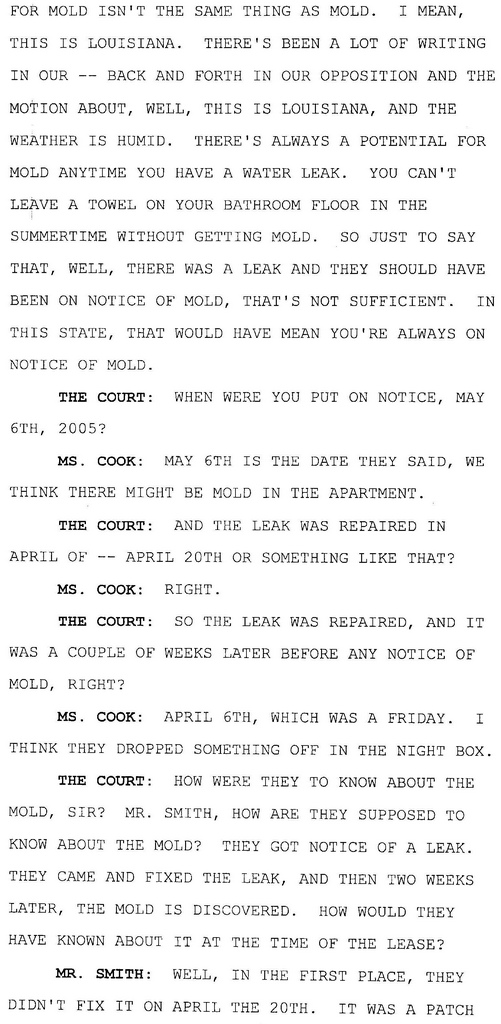
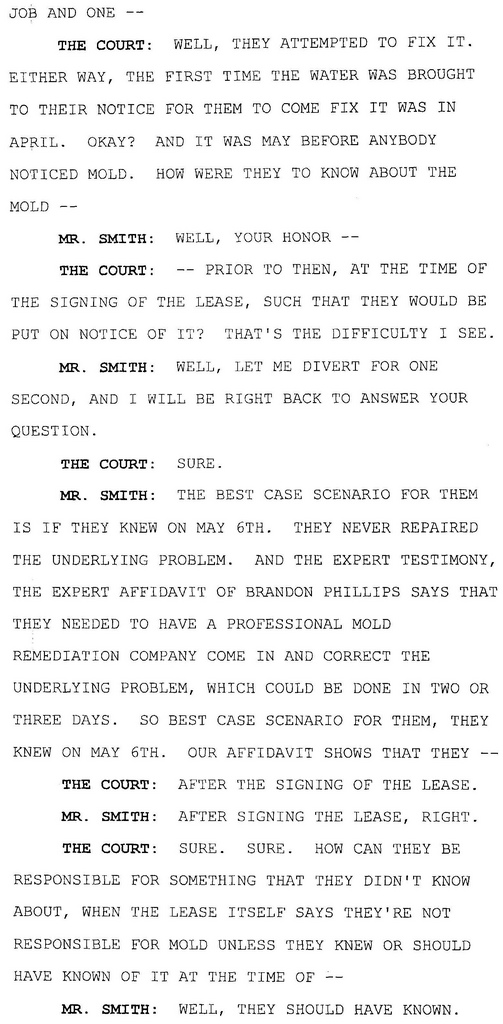
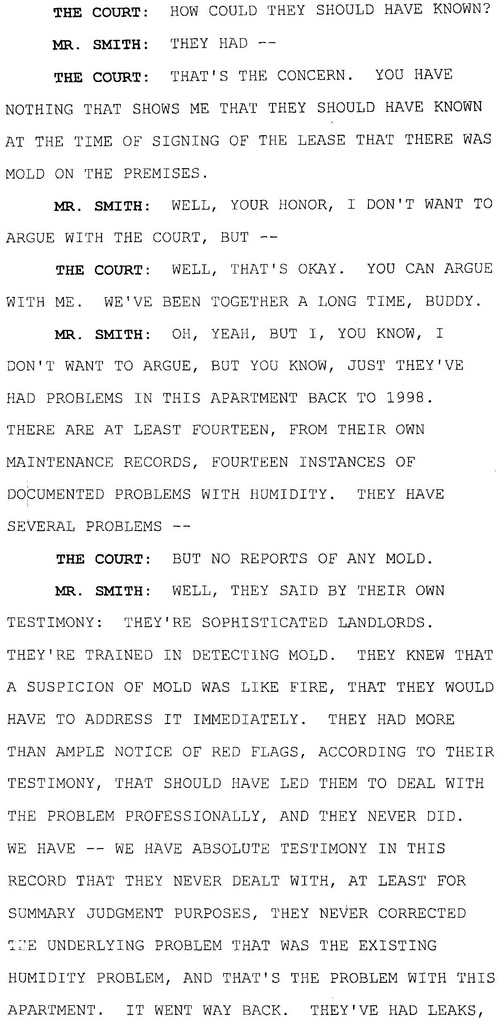
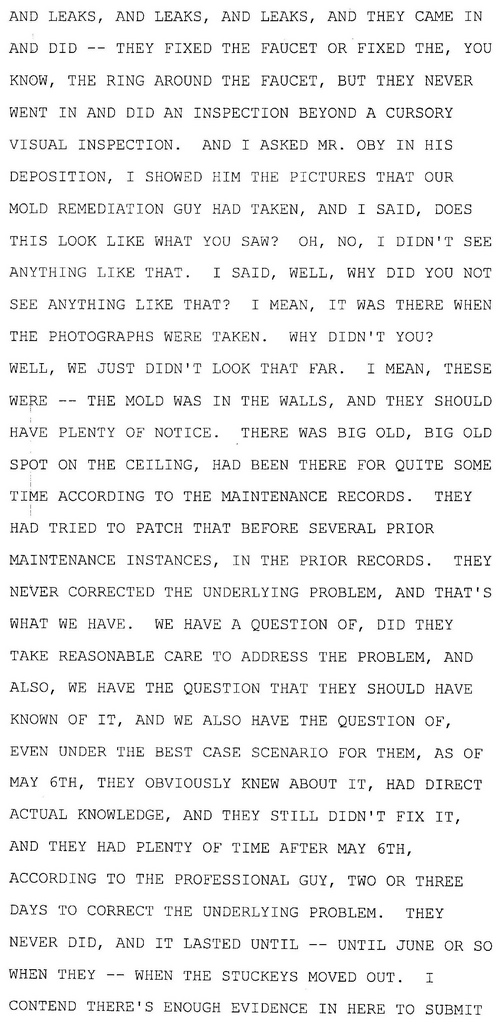
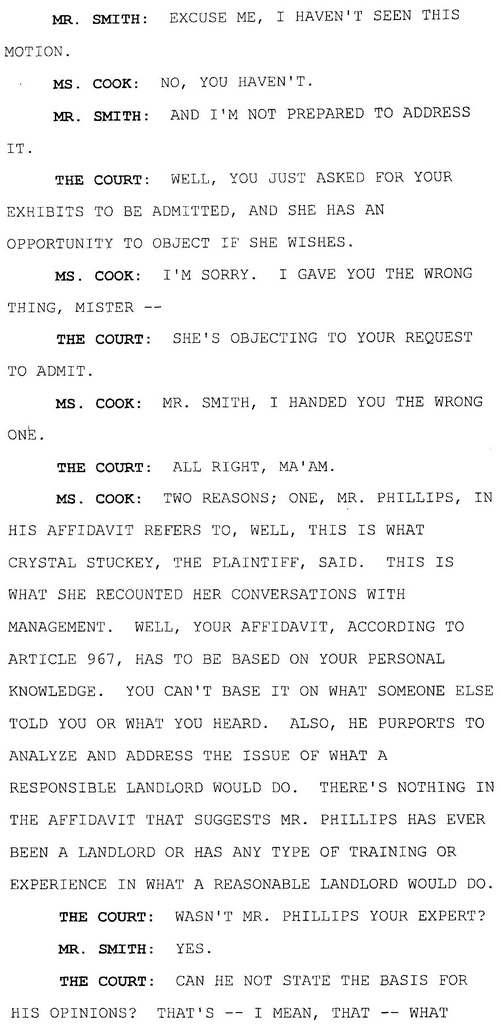
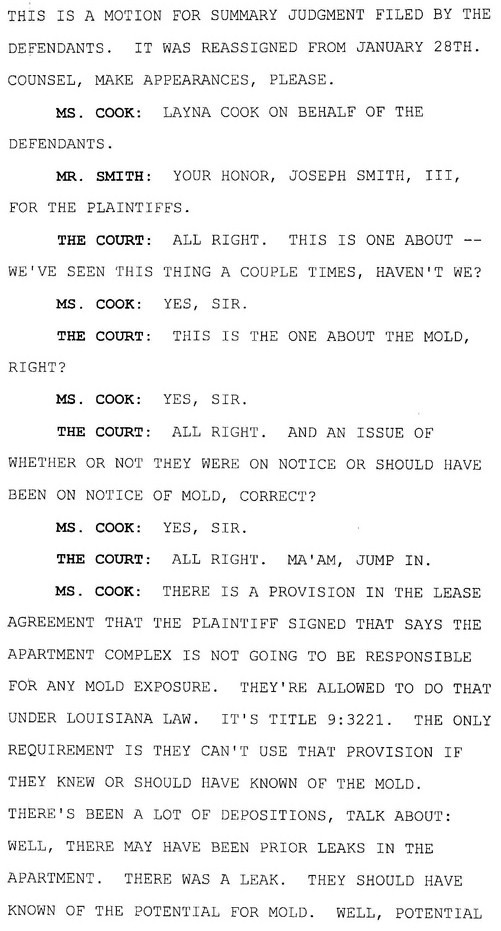
How Litigation against Riverstone Residential gets Dismissed – Court Transcript – Riverstone Residential’s Motion for Summary Judgment – Judge Timothy Kelly – 19th Judicial Court – Baton Rouge, LA

This is an example of the corrupt judicial system. I have more notes to write about this but until then I would like to point out that we did not see the apartment we were leasing and our attorney does not mention that. As far as how was the management company supposed to know there was mold?  Well, they have had to have a mold testing company come out and test before from complaints.  They have the ducts cleaned out on a regular basis and paint over the vents.  There is the 2007 mold report done during the sale of the complex that points out all the mold.  The judges wife is the Commissioner of Administration and on the State Bond Commission that approved the sale of the complex.  Hmmm…

ca12ca2ca3ca4ca5ca61ca7ca8ca9ca10

Posted in Environmental Health Threats, Louisiana Housing Finance Agency, Mold and Politics, Mold Litigation, Riverstone Residential, Toxic Mold | Tagged , , , , , , , , , , , , , , , , , , , , | Leave a comment

Spring Valley Tenants Living in State of Disrepair

Definitly going on the Notorious Landlords List – katy

Suzan Clarke
The Journal News
November 22, 2008

SPRING VALLEY

Tenants at a government-subsidized rental complex are hoping local and federal authorities will force their landlord to quickly finish what they call critical and long-delayed repairs to their apartments.

When it rains, Crystal Alston, a mother of five, says the water comes into her unit through the window frames. Tammy Pettiford says the holes and weak spots in the flooring of her apartment are a constant hazard. Leonard Watson says he’s had part of his ceiling fall in.

Other residents of the Surrey-Carlton apartments on Ewing and Slinn avenues also have complained to Rockland County’s Health Department of similar problems, as well as of rodent infestation and repair requests that go unacknowledged, but owner Kirpal Singh of APS Realty says certain problem tenants constantly undo numerous repairs or fail to make repair requests for fear of exposing overcrowding in the Section 8-subsidized apartments.

According to Alston, work crews started repairs on her apartment, then went away for an entire month before returning. Alston showed visitors to her kitchen, where one side had newer cabinets, while on the other side, the cabinets seemed to be much older and in disrepair.

“See this old ketchup bottle?” she said, opening one cabinet.

An empty plastic bottle was propping up the loaded upper shelf. “If I remove this, it’s all going to fall.”

Pettiford, 34, lives in the apartment with her four children, the youngest of whom has severe asthma. She says the apartment hasn’t been painted in the more than 18 years she’s lived there. She pointed out the loose lock on the front door, a hole in her bedroom floor, and the missing molding on top of her bedroom door.

“When I try to wash my dishes, the guy downstairs gets floods,” Pettiford said.

That man, 62-year-old Watson, said he was mostly content in his apartment, except for the kitchen. Inside the kitchen, visitors were met with the stark sight of a cabinet appearing to be almost detached from the wall and sagging toward the floor. Because he cannot use that cabinet, Watson stores his pots and pans inside a box in his cramped living room.

“It’s been like this for almost six years,” he said. “I feel terrible. It’s a health hazard.”

When the county started hearing about the conditions from residents, Joseph Abate, director the Rockland Office of Community Development – which administers U.S. Department of Housing and Urban Development programs in Rockland – wrote to HUD and visited the tenants. County Executive C. Scott Vanderhoef also has written to HUD of his concerns about the site.

HUD subsidizes the rents of the majority of the tenants through its Section 8 program.

In December 2007, Abate wrote to HUD about the residents’ complaints of a rodent and roach infestation, flooding and mold, and other health and safety issues. A number of other tenants were leery of airing their own complaints for fear of retaliation, he added.

Pettiford and Alston both have said they’ve been denied requests for larger apartments, and they believe it’s because they’ve complained. Singh denied the allegation, saying that the few larger apartments they requested were currently occupied and didn’t become vacant very often.

Abate had eight units inspected for housing quality standards. All of them failed inspection.

HUD responded to Abate’s letter by initiating its own inspection of 24 units in the complex in January, finding systemic deficiencies in both the apartments and common areas – such as damaged or missing lavatory sinks, damaged locks, windows and walls – as well as serious health and safety deficiencies, including missing smoke detectors, missing or peeling paint, missing baseboard heater covers, inoperable windows, missing or damaged cabinets, roaches, mold, exposed wiring and an inoperable toilet.

The complex scored a 53 out of 100. Any score below 60 is considered as not meeting HUD’s physical condition standards.

County health department inspectors have since performed several inspections in response to tenant complaints, resulting in numerous violations against Singh. Some of the violations were issued against tenants.

Tenants bear much of the blame, Singh said, adding that he does his best to keep the 176-unit complex – the majority of which are one-, two- and three-bedroom units – in pristine condition, but that about 30 or so of his renters make his job hard.

“The tenants are destroying the property,” a clearly frustrated Singh said recently at the complex. “I’m telling you, they just destroy it.”

In a December 2007 letter from Abate to APS, Abate discussed the necessary repairs to the eight apartments that he’d had inspected. Although several of the issues were the landlord’s responsibility, tenants also bore responsibility for dirty stovetops, loose floor tiles, a hole “punched in the wall,” a sliding door knocked of the tracks and an entrance door that had been kicked in.

In one apartment, the tenant had removed smoke detectors save one that was inoperable, the report said, adding that the overall appearance of the apartment was “filthy.”

In another unit, inspectors found the apartment “infested with roaches and overrun with cats,” and containing a “very strong smell of ammonia … from all the cat urine in the apartment,” which was determined to be a health hazard not only to the residents of that unit but to people next door.

Repairs to the complex – about $200,000 worth this year, Singh said, are well under way, but he said he cannot control what happens inside tenants’ apartments.

From the outside, the complex appears well kept, with new iron fencing, a newly paved parking lot and courtyards and clean common areas. Work crews were making repairs one afternoon earlier this month.

Abate, who offered Singh $50,000 in federal funding to help with comprehensive repairs, said fixes needed to be done not just to the exterior but to the interior as well.

Singh said he’s committed to doing repairs inside the units, but said tenants will often decline to allow work crews inside. Health department workers have in some cases reported having similar access problems when they’ve gone to do inspections.

“It’s just the same thing again and again and again and we are the ones who get fined and the tenants, they get a free ride. This is a good place, and there are a lot of good tenants,” Singh said. “I’m really surprised how these people are living here. You go to (a) judge, judge don’t throw them out. What I’m going to do? ”

Singh said he’s proud of his complex, adding that he supplies free batteries for smoke detectors and keeps a constant supply of smoke and carbon monoxide detectors, more than 100 new doors as well as new appliances at the ready for repairs.

One tenant, Sandra Stroud, acknowledged Singh was trying to work on the problems.

Thirteen hearings on the county health department violations have been scheduled. The hearing officer’s recommendations will be presented to the commissioners of the county’s Board of Health next month. Each violation could carry a maximum penalty of $1,000 per day.

HUD will conduct another comprehensive inspection next month to check that the promised repairs have been made. Failure to maintain adequate housing quality standards at the site could result in ineligibility to participate in the subsidy program.

article

For a video with this report, visit – lohud.com

Posted in Environmental Health Threats | Tagged , , , , , , , , , , , , , , , | Leave a comment