
Bailed out homebuilders collect fat paychecks

Helen Chernikoff
NEW YORK
May 6, 2010

(Reuters) – No one rode the U.S. housing bubble higher than the company that calls itself “America’s Builder,” D.R. Horton Inc (DHI.N).

During the boom years, Horton and its peers sprawled across the map, opening new divisions and buying up smaller fry in an industry-wide frenzy of expansion and acquisition.

In 2006, the year home prices peaked, D.R. Horton’s sales did as well, with 53,099 home sales closed. Its founder predicted the company would break the 100,000-unit barrier by 2010.

That will not happen — not this year, not anytime soon.

Horton sold just 16,703 homes in 2009. Since the depths of the downturn in 2007, the company has lost more than $3.9 billion and laid off 53 percent of its workers.

But Horton has seen robust growth in one area: executive pay. The company’s founder and chairman, D.R. Horton, made $17.6 million from 2007 to 2009, as his annual compensation jumped from $2 million to $7.6 million, according to Equilar, a research firm that specializes in pay.

His chief executive, Donald Tomnitz, received a similar pay hike. Both will receive raises in base salary this year.

The two were not the only ones who profited handsomely during the most perilous stretch in their industry’s history, when homebuilders fired nearly half their workforce and lost more than half their market cap.

While Wall Street bankers have received far more scrutiny — and grief — for their fat paychecks, homebuilder executives have been doing quite well for themselves. In 2007 and 2008, the CEOs of the 10 biggest U.S. homebuilders earned an average of about $6 million a year each in total compensation.

And although banks and automakers got bigger bailouts from the government, homebuilders certainly got their share. This came in the form of tax benefits for buyers, tax refunds for builders and policies that kept mortgage rates low and foreclosures off the market.

“Without the government’s support, in all likelihood we would have seen more failures among the builders,” said Mark Zandi, chief economist at Moody’s Economy.com. “It’s almost hard to list all the things that have been done to support homebuilding either directly or indirectly.”

The federal homebuyer tax credit, which has provided up to $8,000 for homebuyers, cost taxpayers about $25 billion, Zandi said, while the tax refund amounted to a $5 billion cash cushion for big builders’ balance sheets. Individual states, such as California, helped out, too, offering their own baskets of tax benefits and breaks for homebuyers.

Of course, homebuilding executive pay — including that of Horton and Tomnitz — isn’t what it was at the top of the market, when predatory lenders pushed few-questions-asked loans on people who could not afford them. In 2005 alone, for example, Horton and Tomnitz each took home cash bonuses of almost $13 million.

Then again, some investors say homebuilders were overpaid during the boom, when Bob Toll of Toll Brothers Inc (TOL.N), R. Chad Dreier of Ryland Group (RYL.N) and Larry Mizel of MDC Holdings Inc (MDC.N) took home compensation and stock sales in the hundreds of millions.

“Homebuilding is highly cyclical. You can’t blame that on corporate management nor should you give them credit when there is an upturn,” said Eric Marshall, director of research for Hodges Capital Management, which owns shares of No. 1 builder PulteGroup Inc (PHM.N). “CEO compensation needs to be better balanced, especially in cyclical industries.”

D.R. Horton declined to comment for this article.

LOCATION, LOCATION, LOCATION

Homebuilding falls in a sector known as consumer durables. That’s the technical term for the big-ticket items that cost consumers not just money but often sleep — such as houses and some of the stuff inside them. Besides homebuilders, the sector includes companies like appliance maker Whirlpool Corp (WHR.N) and furniture retailer Ethan Allen Interiors Inc (ETH.N).

But CEOs whose companies build homes make more money — four to five times more — than their counterparts who manufacture couches and washing machines, said Robin Ferracone, executive chair at compensation consultant Farient Advisors. She and others attribute homebuilders’ outsized pay to a quirk of the industry: the involvement of founders and their sons in companies such as Horton, Toll Brothers, MDC Holdings, Lennar Corp (LEN.N) and Hovnanian Enterprises (HOV.N).

“When a homebuilding company goes public, it often doesn’t make that psychological transition to being a public company,” Ferracone said. “They pay themselves as if they were private.”

For example, MDC Holdings gave Larry Mizel a $2 million bonus, plus restricted stock, in 2007, when the company lost $636.9 million. An income-based formula was “unfair and inappropriate” given Mizel’s ability to preserve the company and position it for future success, according to the proxy.

Mizel’s compensation dipped in 2008, but by 2009, at $7.8 million, was starting to recover and had rebounded almost to its 2007 level.

MDC Holdings also declined to comment for this article.

Unlike Mizel, Hovnanian’s chief executive did not receive a discretionary bonus, or indeed any bonus, in 2007. Instead, he went without until the next year, when his board revised its bonus program to peg his award to the reduction of debt, much of which accumulated on his watch.

Long the most leveraged homebuilder, Hovnanian also fired 60 percent of its workers between 2007 and 2009. It lost $2.47 billion during that time. Its share price was hammered, falling from a high of $73.40 in July 2005 to a low of $0.52 in March of last year.

CEO and Chairman Ara Hovnanian did manage to cut debt from $2.47 billion in 2008 to $1.77 billion in 2009. He did so by buying out some bondholders at a loss and then issuing more debt at a discount and higher interest rates, said bond analyst Vicki Bryan of Gimme Credit. Standard & Poor’s, the ratings agency, called the action “tantamount to a default” and a “de facto debt restructuring.”

For this, he received $1.5 million in 2008, and $699,500 the next year. The company also paid his country club fees, and let him use its plane and cars for personal use. Unlike its peers, Hovnanian has not purged its compensation of such perks.

The company’s compensation committee said it wanted Ara Hovnanian to focus on debt reduction because it wanted sufficient liquidity to exploit opportunities during the recovery, Chief Financial Officer Larry Sorsby said.

The company also froze Hovnanian’s salary at a little over $1 million, and cut his total compensation to $2.7 million in 2009, from $5.4 million in 2007.

Not every homebuilder executive sought to grow, or at least maintain, his pay during the downturn. Meritage Homes Corp (MTH.N) Chief Executive Steven Hilton took a voluntary pay cut and turned down his bonus during the worst years.

His total compensation, already at the lower end compared to his counterparts at comparable builders, fell 29 percent between 2007 and 2009 to $2.5 million.

But Meritage is one of the few exceptions.

FOR WHOM THE BELL TOLLS

At Toll, the board revamped its entire CEO bonus plan in 2007 “to develop a bonus program that would work effectively in all economic climates,” according to the proxy. The plan had generated excessive compensation during the boom and eliminated bonuses altogether during the bust, Chief Financial Officer Joel Rassman explained.

Under the revised plan, Bob Toll technically earned bonuses of $5.2 million in both 2008 and 2009, years the company lost about $1 billion. But the board canceled them “due to overall economic conditions” and gave him restricted stock instead.

Of course, even $5.2 million is only 2.5 percent of the $212.9 million Toll took in between 2006 and 2010 selling shares of his company, according to Ben Silverman of InsiderScore.com.

Toll and Hovnanian’s prominence complicates the industry’s image because they represent housing to Congress and to the public, said John McManus, editorial director for a slate of homebuilding trade publications, including Big Builder.

“Is this guy a greedy banker or a good guy who tries to build housing for people who can’t afford it?” McManus said.

The growth of his company generated wealth for shareholders as well as Toll, Rassman said: “As the CEO of a company he needs to do what is right for the industry, and what is right for America.”

Toll focused his lobbying efforts on policies that would generate jobs, such as a tax credit for only newly constructed homes that never passed, Rassman said.

KING CASH

Like MDC Holdings, KB Home’s (KBH.N) board exercised its discretion in 2007 — but on a far grander scale, handing a $6 million bonus to CEO Jeffrey Mezger in his first year on the job for cutting debt and headcount and improving the company’s customer satisfaction levels. The company lost $929.4 million that year.

KB, too, declined to comment for this story.

Other builders simply revised their compensation metrics.

Horton, Pulte, Ryland, and Beazer Homes USA Inc (BZH.N) opted in 2007 to reward cash generation in addition to income with the result that their CEOs did not go without bonuses in 2008 or 2009.

Beazer could not be reached for comment on this story. KB and Pulte declined to comment.

Ryland’s Dreier got a $2.5 million bonus in 2008, when his total compensation was $8.1 million, virtually unchanged from 2007.

In 2009, Horton and Tomnitz each received $2.3 million.

Ryland said the bonus was intended to motivate Dreier to ramp up its cash position. If profits proved elusive that year, the company would need to have funds on hand to make money once the industry recovered, said Ryland spokesman Eric Elder.

But investors who understand cash’s importance questioned the need for a bonus in such dire times.

“They’re being selective and self-serving,” said Todd Lowenstein, portfolio manager for the HighMark Value Momentum Fund, which used to own Pulte shares. “In an environment like this, you don’t need to shower CEOs with additional compensation. The environment is going to motivate them.”

What’s more, Washington helped CEOs secure those bonuses. An accounting change known as the “net operating loss lookback” was particularly helpful here.

The lookback, which has been on the books for years and was extended in 2009, allows businesses to recoup old taxes by reducing a past profit by the amount of a current loss.

And the policy will ultimately give builders back $4.8 billion, according to Deutsche Bank analyst Nishu Sood.

The lookback aims to smooth distortions caused by the annual accounting period and was not designed with homebuilders in mind, said Deloitte Tax Principal Clint Stretch.

“If they weren’t profitable, why should the government have gotten any income tax?” Stretch asked.

But the government’s 2009 decision to extend the policy will greatly benefit builders and applies most neatly to them, said Douglas Shackelford, a professor of tax at the University of North Carolina’s Kenan-Flagler Business School.

Few other companies can apply large losses incurred in 2007 through 2009 to large profits made in 2004 through 2006, Shackelford said.

“Every time there’s a downturn, there’s some group that gets hit harder than anybody else. But it doesn’t follow that they should get more help than anybody else,” he said.

LOOK BACK IN ANGER

In recent quarters, tax refunds from the lookback extension made the difference between profit and loss, enabling most of the builders to post their first paper profits in years.

“It’s like you’re walking down the street and you see a bag of money and you get an award because your bank account balance went up,” said Bryan of Gimme Credit.

The lookback also gave big builders an extra edge over smaller rivals.

Selling land was one of the easiest ways to book a loss that would generate a refund, so the lookback motivated them to dump inventory bought at peak-era prices. They then used the cash refund to buy choice parcels on the cheap.

Smaller builders protested that those land sales further hurt land and home prices, and that big builders’ refunds bought coveted land positions that will translate into competitive advantage and marketshare.

Many of the big builders made the lookback a big priority. In early 2009, Hovnanian’s CEO was spending 70 percent of his time lobbying for it, Sorsby told investors at the time. It even helped precipitate a split in the industry, with the bigger players forming an alternative trade organization.

The government hoped that the main beneficiaries would start hiring, and there is some evidence that is happening.

Miami-based Lennar, which laid off 44.7 percent of its workforce between 2007 and 2009, says it has already hired 50 people and plans to hire more in the near future.

RECOVERING BUILDER-HOLICS

Lennar and indeed most homebuilders are feeling more optimistic these days than they have in years as the U.S. economy gradually improves and the wobbly housing recovery shows signs of solidifying.

Nationally, sales of new homes rose 26.9 percent in March, the largest increase since April 1963. The heightened demand boosted orders across the sector. Meritage, Horton and Beazer all reported surprise profits.

Horton is so confident it can make money in 2010 it has revised its bonus metric back to pre-tax income, “a performance goal we had historically used before the housing downturn,” according to the company’s most recent proxy.

But given the stubbornly high unemployment rate, most recently reported by the Labor Department at 9.7 percent, the housing recovery could yet stall as the government withdraws its supports for the industry.

In March, the Federal Reserve terminated its program of purchasing mortgage-related debt, which had helped keep interest rates low and homes more affordable, as did the homebuyer tax credit that expired on April 30.

“The economic backdrop remains difficult. Foreclosure rates remain at record levels, which keeps home values down and depresses potential demand,” Bryan said.

Optimism based on March’s new home sales number is a mistake, said real estate consultant John Burns, whose eponymous firm is located in Irvine, California.

March “was still one of the worst month’s of all time,” he said. “We survey approximately 2,000 communities every month, and sales were not that robust.”

Estimates on the recovery’s timing vary, but even the more sanguine prognosticators say builders might have to wait another year or more to really make money. That means investors might again take a hit as their share prices, up 27 percent this year according to the Dow Jones U.S. Home Construction Index .DJUSHB, deflate.

In that event, homebuilder CEO pay may come to reflect the industry’s travails.

“On Wall Street, if you’re managing money and you have a loss for the year you’re not likely to see a large bonus. That’s the way the world works,” Hodges Capital Management’s Marshall said. “They should participate in the downturn just like the shareholders.”

(Additional reporting by Steve Eder, editing by Jim Impoco and Claudia Parsons)

reuters.com

TRUTH OUT Sharon Kramer Letter To Andrew Saxon MOLD ISSUE

New Action Committee – ACHEMMIC- Urges Transparency in EPA Policy Over Mold & Microbial Contaminants

Truth About Mold – the most up to date, accurate, and reliable information on Toxic Mold

FEMA Using US Chamber Fraud in Katrina Trailer Litigation; EPA, GAO & Both Isle$ of Congre$$ Turn Blind Eye$

Sociological Issues Relating to Mold: The Mold Wars

Certain Corporate and Government Interests Have Spent Huge Sums of Money and Resources DENYING THE TRUTH about the HEALTH EFFECTS of TOXIC MOLD

Political Action Committee – National Apartment Association (NAA) files Amicus Brief in mold case (two infant deaths in mold filled apt – Wasatch Prop Mgmt) citing US Chamber/ACOEM ‘litigation defense report’ to disclaim health effects of indoor mold & limit financial risk for industry

“Changes in construction methods have caused US buildings to become perfect petri dishes for mold and bacteria to flourish when water is added. Instead of warning the public and teaching physicians that the buildings were causing illness; in 2003 the US Chamber of Commerce Institute for Legal Reform, a think-tank, and a workers comp physician trade organization mass marketed an unscientific nonsequitor to the courts to disclaim the adverse health effects to stave off liability for financial stakeholders of moldy buildings. Although publicly exposed many times over the years, the deceit lingers in US courts to this very day.” Sharon Noonan Kramer

Information on Riverstone Residential, the Louisiana Housing Finance Agency, and the owners of Toxic Mold Infested Jefferson Lakes Apartments in Baton Rouge, Louisiana continuing to allow tenants to be exposed to extreme amounts of mold toxins

Irrefutable evidence indicates that Riverstone Residential, Guarantee Service Team of Professionals, & plaintiffs’ attorney, J Arthur Smith III, must have agreed to exclude evidence that would have shown the owners of Jefferson Lakes Apartments & Riverstone Residential had knowledge of the severe MOLD INFESTATION at the complex before we moved in

Toxic Mold Infested Jefferson Lakes Apartments managed by Riverstone Residential
Riverstone Residential Litigation

Mold Inspection Reports

Photos of Mold in Apartment

Attorney Malpractice

Posted in Politics | Tagged , , , , , , , , , , , , , , , , | Leave a comment

Environmental Protection Agency ripped over foot-dragging on PCB tests at schools – Too costly to enforce PCB laws, so change them

BY Bill Egbert
DAILY NEWS STAFF WRITER
May 5th 2010

Parents, scientists and officials blasted the federal Environmental Protection Agency Tuesday at a hearing on whether to relax safety standards for toxins in public schools.

“We’re questioning the motives behind this,” said Deputy Bronx Borough President Aurelia Green. “It doesn’t look like it’s being done in the interest of students and school employees.”

The hearing – on a proposal to change limits set in 1979 on polychlorinated biphenyls (PCBs) – comes after a Daily News investigation found PCBs in the caulking of several public schools at levels thousands of times higher than what’s considered safe.

When PCBs were outlawed for most uses 30 years ago, EPA regulations declared that anything with concentrations of 50 parts-per-million must be removed.

A 2008 Daily News investigation found PCB levels as high as 225,000 ppm in the caulking of several public schools.

When it proposed a rule change, the EPA specifically cited the burden that removing contaminated caulking would impose on schools. Most of those who testified said any change should be based on science and safety rather than on financial issues.

Ann Casey, a PCB expert at Northeast Analytical Labs, said that based on the latest science, the standard should be tightened, not loosened.

“A study that I did myself of very low levels of PCB exposure in the air showed negative health effects in rats,” said Casey, who has studied PCBs for 22 years.

Earlier this year, the city Department of Education reached a settlement with the EPA to do pilot studies in order to develop a plan for dealing with PCB caulk in the schools.

Several speakers blasted the EPA for trying to relax standards before studies are complete.

“This method of dealing with the problem is something we would have expected from the previous administration,” said Green.

“The Obama administration is better than this.”

nydailynews.com

EPA: Too costly to enforce PCB laws, so change them

TRUTH OUT Sharon Kramer Letter To Andrew Saxon MOLD ISSUE

New Action Committee – ACHEMMIC- Urges Transparency in EPA Policy Over Mold & Microbial Contaminants

Truth About Mold – the most up to date, accurate, and reliable information on Toxic Mold

FEMA Using US Chamber Fraud in Katrina Trailer Litigation; EPA, GAO & Both Isle$ of Congre$$ Turn Blind Eye$

Sociological Issues Relating to Mold: The Mold Wars

Certain Corporate and Government Interests Have Spent Huge Sums of Money and Resources DENYING THE TRUTH about the HEALTH EFFECTS of TOXIC MOLD

Political Action Committee – National Apartment Association (NAA) files Amicus Brief in mold case (two infant deaths in mold filled apt – Wasatch Prop Mgmt) citing US Chamber/ACOEM ‘litigation defense report’ to disclaim health effects of indoor mold & limit financial risk for industry

“Changes in construction methods have caused US buildings to become perfect petri dishes for mold and bacteria to flourish when water is added. Instead of warning the public and teaching physicians that the buildings were causing illness; in 2003 the US Chamber of Commerce Institute for Legal Reform, a think-tank, and a workers comp physician trade organization mass marketed an unscientific nonsequitor to the courts to disclaim the adverse health effects to stave off liability for financial stakeholders of moldy buildings. Although publicly exposed many times over the years, the deceit lingers in US courts to this very day.” Sharon Noonan Kramer

Information on Riverstone Residential, the Louisiana Housing Finance Agency, and the owners of Toxic Mold Infested Jefferson Lakes Apartments in Baton Rouge, Louisiana continuing to allow tenants to be exposed to extreme amounts of mold toxins

Irrefutable evidence indicates that Riverstone Residential, Guarantee Service Team of Professionals, & plaintiffs’ attorney, J Arthur Smith III, must have agreed to exclude evidence that would have shown the owners of Jefferson Lakes Apartments & Riverstone Residential had knowledge of the severe MOLD INFESTATION at the complex before we moved in

Toxic Mold Infested Jefferson Lakes Apartments managed by Riverstone Residential

Riverstone Residential Litigation

Mold Inspection Reports

Photos of Mold in Apartment

Attorney Malpractice

Posted in Environmental Health Threats, Health - Medical - Science, Politics | Tagged , , , , , , | Leave a comment

UCF and Pegasus Landing in Fight over Mold

May 8, 2010 

Just about two months after KnightNews.com’s investigative unit was first to uncover a mold infestation forced UCF student Albert Piedrahita out of his Pegasus Landing Apartment — after he was initially told to leave for “standard renovations” — the situation has come to a boiling point.

On one side is the University of Central Florida, which owns the land Pegasus Landing sits on, and announced on Friday it is suspending its affiliation ties with Pegasus Landing over the mold.

On the other side is a company called CaPFA Capital Corp. 2000F, a Florida nonprofit corporation, which owns the apartment buildings where students live.

Caught in the middle are thousands of current UCF students, RA’s and future Knights who have leases at a property UCF promised was “affiliated” with the university.

knightnews.com

STATEMENT: Read UCF Statement

STATEMENT: Read Pegasus Landing Statement

UCF Student: Mold Caused Hospitalization

TRUTH OUT Sharon Kramer Letter To Andrew Saxon MOLD ISSUE

New Action Committee – ACHEMMIC- Urges Transparency in EPA Policy Over Mold & Microbial Contaminants

Truth About Mold – the most up to date, accurate, and reliable information on Toxic Mold

FEMA Using US Chamber Fraud in Katrina Trailer Litigation; EPA, GAO & Both Isle$ of Congre$$ Turn Blind Eye$

Sociological Issues Relating to Mold: The Mold Wars

Certain Corporate and Government Interests Have Spent Huge Sums of Money and Resources DENYING THE TRUTH about the HEALTH EFFECTS of TOXIC MOLD

Political Action Committee – National Apartment Association (NAA) files Amicus Brief in mold case (two infant deaths in mold filled apt – Wasatch Prop Mgmt) citing US Chamber/ACOEM ‘litigation defense report’ to disclaim health effects of indoor mold & limit financial risk for industry

“Changes in construction methods have caused US buildings to become perfect petri dishes for mold and bacteria to flourish when water is added. Instead of warning the public and teaching physicians that the buildings were causing illness; in 2003 the US Chamber of Commerce Institute for Legal Reform, a think-tank, and a workers comp physician trade organization mass marketed an unscientific nonsequitor to the courts to disclaim the adverse health effects to stave off liability for financial stakeholders of moldy buildings. Although publicly exposed many times over the years, the deceit lingers in US courts to this very day.” Sharon Noonan Kramer

Information on Riverstone Residential, the Louisiana Housing Finance Agency, and the owners of Toxic Mold Infested Jefferson Lakes Apartments in Baton Rouge, Louisiana continuing to allow tenants to be exposed to extreme amounts of mold toxins

Irrefutable evidence indicates that Riverstone Residential, Guarantee Service Team of Professionals, & plaintiffs’ attorney, J Arthur Smith III, must have agreed to exclude evidence that would have shown the owners of Jefferson Lakes Apartments & Riverstone Residential had knowledge of the severe MOLD INFESTATION at the complex before we moved in

Toxic Mold Infested Jefferson Lakes Apartments managed by Riverstone Residential

Riverstone Residential Litigation

Mold Inspection Reports

Photos of Mold in Apartment

Attorney Malpractice

Posted in Environmental Health Threats, Health - Medical - Science, Tenants Rights, Toxic Mold | Tagged , , , , , , , , , , , | Leave a comment

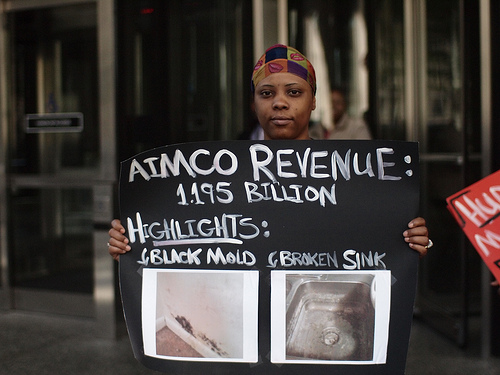
Family of Six Faces Eviction in Rogers Park – Northpoint Apartments publicly subsidized by HUD, owned by AIMCO

5-7-2010


A Northpoint tenant holds a sign in front of HUD headquarters with pictures of black mold and a broken sink taken inside her apartment. Photo by Isaac Silver.

Carol Vialdores and her children have lived in Rogers Park for 16 years. Currently residing near the Chicago-Evanston border off of Howard Street, the family has never lived anywhere besides the Far North Side.

“The kids have never changed schools,” she says. “It’s where they’ve spent their whole lives.”

Vialdores, 41, and her five children, ages five to 19, live at the Northpoint Apartments. For now. The Vialdores family is facing an eviction. Northpoint management claim Vialdores violated several aspects of her lease, including threatening a manager, and are attempting to remove her and her children from their home. She and the Chicago Anti-Eviction Campaign (CAEC) say her eviction is a response to her active role in organizing with a tenants union at Northpoint for better living conditions, and are mobilizing with community members and other tenants to demand the family be left in their home.

Vialdores and Northpoint began their trial this week. The verdict will determine whether or not the family will get to keep a roof over their heads.

“MANAGEMENT DOESN’T WANT ANYTHING TO CHANGE”

The Vialdores family resides in an apartment complex publicly subsidized by the Department of Housing and Urban Development (HUD) through project-based Section Eight funding. The complex is owned by AIMCO, a Denver-based property management company and the largest owner and operator of apartments in the country. HUD pays AIMCO market rates for the apartments, and tenants pay AIMCO one-third of their income.

Vialdores and her family depend on the subsidy, as she is currently unemployed. But she and other Northpoint residents say their apartments are in near “unlivable” conditions.

Northpoint grabbed headlines last year when management attempted to evict Erica Bledsoe, a tenant who became the legal guardian of her nieces and nephew after their grandmother Rosetta died unexpectedly. Erica moved into the apartment when her mother became ill with lung disease; her condition quickly worsened, and after she died, Erica and the children were told they had 10 days to vacate the apartment.

The case affected Carol greatly.

“Rosetta was a very strong person. And I can see her in Erica,” she said.

The CAEC fought the order, and Bledsoe’s eviction was eventually stopped when HUD intervened. Vialdores, who is friends with Bledsoe, said Erica’s victory was an inspiration for her and other tenants to get involved with the North Point Tenants Association, a CAEC affiliate.

“When we showed we could fight back and win, people felt like there was some hope,” Vialdores said.

After the victory, Bledsoe told Vialdores she needed to stand up for herself in the apartments.

“She encouraged me to get involved, told me not to be afraid. She always told me to keep strong, to not give up, and that a lot of people would support me — and they have.”

Holly Krig, a volunteer coordinator for CAEC and a former organizer for Northside Action for Justice, says Carol soon became the leading face in Northpoint organizing.

“She was the most visible tenant” in the NPTA, she said.

Soon, Vialdores was passing out fliers and organizing meetings with other residents to fight for improved living conditions. Tenants had a number of issues they wanted addressed, but were hesitant about fighting for them.

“Everyone’s been afraid. We’re trying to get people to lose that fear.”

HUD provisions allow for organizing among residents, but that didn’t mean management was happy.

“They didn’t want us to organize because there are a lot of things they don’t want to come out,” claimed Carol. “Once we’re organized, we can start to change some of those things. But [management] doesn’t want anything to change.”

THE “SETUP”

It was this activity, claims CAEC, that fueled the effort to remove the Vialdores family from their home.

In April, 2009, Carol says she went to the property managers’ office to submit a work order for a recurring problem with a sliding door. Northpoint management informed her that she would have to pay for it herself. An argument quickly began, and management threatened to call the police if she did not leave. Carol claims she had put in few orders in the past, and says she has paid for work herself when she thought it proper.

The incident was not the first time relations had become tense between her and management — in 2007, she went over the building manager’s head and called AIMCO about changing her locks in the wake of an incident of domestic violence with her husband. The manager demanded $70; AIMCO changed them for free. The manager, she says, was angry.

“Since then, she’s always had a grudge against me,” Vialdores claimed.

Last year, a small fire damaged a bedroom, and Carol came to an agreement with the manager to pay for the repairs. But when another apartment staff member inspected her house, Carol says the staffer began to pick a fight with her about the fire. Northpoint management claims that during this argument, Carol threatened a staff person. Alleging this is a lease violation, it is one of four charges the company has filed in their attempt to evict the Vialdores family.

Carol feels the process was a “setup.”

“[The manager] was trying to get me angry, doing anything to get me in trouble. And it worked.”

The Northpoint manager in question declined to comment.

As the basis for their eviction, the company cites the alleged threat and claims another was made on a different occasion; in addition, they say her husband was living in her apartment (a third violation), and the fire makes a fourth. She denies all the claims and, when given a 10-day eviction notice in May, 2009, went straight to a lawyer.

Vialdores’s biggest concern is having an eviction on her record. If she and her children are evicted, they will never be able to rent a publicly subsidized apartment again — a serious problem for someone barely hovering above joblessness. And if they are forced to relocate, Carol is unsure what will happen to her 17-year-old daughter Beoncia, who is nearing graduation from high school and hopes to attend college.

Beyond the practical concerns, Carol has been pained by the process.

“It’s taking a lot out of me,” she explained. “I feel real hurt. I’ve been going through anxiety attacks, I find myself crying at night.

“They’re not just evicting me — they’re evicting my whole family.”

“WE DEMAND THAT HUD INTERVENE”

On Monday, a small crowd of supporters gathered in front of HUD’s Chicago headquarters near Clark and Jackson as Vialdores and Krig delivered 500 petition signatures to the agency requesting their intervention in the eviction.

CAEC member Frank Edwards called the case “pretty straightforward.”

“Northpoint is retaliating for Carol’s organizing, using the alleged threat as an excuse to evict her,” he claimed.

Keeanga Taylor, another CAEC organizer, condemned AIMCO for their actions.

“The company is not really interested in people’s living conditions,” she stated.

She implored HUD to stop AIMCO from forcing the Vialdoreses out, as the agency had done in the case of Erica Bledsoe.

“Evictions are catastrophic events in people’s lives,” Taylor told the crowd. “HUD was established to provide housing for low-income people. Instead of evicting people at a time when there is an eviction crisis happening around this city and around the country, they should be trying to figure out solutions to expand housing opportunities for people, to keep families together and to keep people in their homes.”

Vialdores’s fellow Northpoint tenants joined the crowd, some holding signs with pictures they claimed showed unfulfilled work orders and unsafe living conditions in their apartments.

“They treat us like we’re nothing,” said Anthony Burns, a fellow Northpoint resident for 16 years.

Eva Holland an unemployed caseworker in Rogers Park who does volunteer social service referrals for Northpoint residents, said tenants will continue to organize if HUD doesn’t step in.

“If HUD doesn’t want to take responsibility, the tenants are going to take responsibility,” she said.

Vialdores was allowed into the building to deliver the petitions. She said HUD was cordial, accepting the petitions and listening to her story, but offered no promises.

A HUD spokesperson would not comment on the case.

“WE’D PROBABLY MOVE INTO A SHELTER”

Vialdores has her day in court, and her lawyer, John Elston, feels their likelihood of winning is good.

“We have a reasonable chance. It’s just their word against Carol’s,” he explained.

But her future remains uncertain. When asked in front of HUD headquarters what she will do if her family is evicted, she paused, gazing past the crowd as if the answer could be found a few blocks north on Clark Street.

“We’d probably move into a [homeless] shelter,” she said, shaking her head with a hint of sadness in her voice.

She quickly moved on from the thought, as she and Krig left to present the signatures. Vialdores received her eviction notice over a year ago, but the prospect of leaving the neighborhood where her children had grown up still seemed distant and unreal.

As the two women entered HUD headquarters, Northpoint resident Anthony Burns thought about his 16 years in a subsidized apartment. He is well-established at the complex, but after seeing Vialdores face eviction, he worries his decade-and-a-half tenure might not be enough to keep him in his home.

“If they evict Carol,” he asked, “what’s to stop them from evicting anyone else?”

This feature is supported in part by a Community News Matters grant from The Chicago Community Trust and the John S. and James L. Knight Foundation. Learn more here.

gapersblock.com

More mold complaints against apartment complex – Follow up to – Jacksonville mom says apartment mold, asbestos caused son’s asthma death – Village of Baymeadows Apartments

Stimulus funds aiding companies fined for pollution (Boeing), accused of fraud (Granite Construction) & AIMCO – a major apartment owner based in Denver – offered $13 million in tax credits – paid $3 million to settle a lawsuit over complaints that it operated mold and rodent-infested buildings

Gimme Shelter – Tax Shelter-Funded Affordable Housing – Affordable Housing Kings

Video – Trussville family settles with HUD over mold infestation

Editorial: HUD props up an apartment complex failing its tenants

Stimulus funds flow to troubled Oak Cliff apartment complex – Ridgecrest Terrace – Rene Campos Jr – Eureka Holdings

Tenants protest at City Hall ‘slum’ living conditions – building owner Leon Finney sits on Chicago Plan Commission

Government Workers – HUD – Say Building Makes Them Sick – years of on & off roof leaks – mold – stachybotrys

Stim Bucks for Slumlords? Slumlords get share of $81M stimulus, despite code violations on buildings

Sweeping Public Housing Needs Study (HUD) Gets Under Way – CAS FAS will assess condition of portfolio & funding needs

TRUTH OUT Sharon Kramer Letter To Andrew Saxon MOLD ISSUE

New Action Committee – ACHEMMIC- Urges Transparency in EPA Policy Over Mold & Microbial Contaminants

Truth About Mold – the most up to date, accurate, and reliable information on Toxic Mold

FEMA Using US Chamber Fraud in Katrina Trailer Litigation; EPA, GAO & Both Isle$ of Congre$$ Turn Blind Eye$

Sociological Issues Relating to Mold: The Mold Wars

Certain Corporate and Government Interests Have Spent Huge Sums of Money and Resources DENYING THE TRUTH about the HEALTH EFFECTS of TOXIC MOLD

Political Action Committee – National Apartment Association (NAA) files Amicus Brief in mold case (two infant deaths in mold filled apt – Wasatch Prop Mgmt) citing US Chamber/ACOEM ‘litigation defense report’ to disclaim health effects of indoor mold & limit financial risk for industry

“Changes in construction methods have caused US buildings to become perfect petri dishes for mold and bacteria to flourish when water is added. Instead of warning the public and teaching physicians that the buildings were causing illness; in 2003 the US Chamber of Commerce Institute for Legal Reform, a think-tank, and a workers comp physician trade organization mass marketed an unscientific nonsequitor to the courts to disclaim the adverse health effects to stave off liability for financial stakeholders of moldy buildings. Although publicly exposed many times over the years, the deceit lingers in US courts to this very day.” Sharon Noonan Kramer

Information on Riverstone Residential, the Louisiana Housing Finance Agency, and the owners of Toxic Mold Infested Jefferson Lakes Apartments in Baton Rouge, Louisiana continuing to allow tenants to be exposed to extreme amounts of mold toxins

Irrefutable evidence indicates that Riverstone Residential, Guarantee Service Team of Professionals, & plaintiffs’ attorney, J Arthur Smith III, must have agreed to exclude evidence that would have shown the owners of Jefferson Lakes Apartments & Riverstone Residential had knowledge of the severe MOLD INFESTATION at the complex before we moved in

Toxic Mold Infested Jefferson Lakes Apartments managed by Riverstone Residential

Riverstone Residential Litigation

Mold Inspection Reports

Photos of Mold in Apartment

Attorney Malpractice

Posted in Environmental Health Threats, Tenants Rights, Toxic Mold | Tagged , , , , , , , , , , , , , , , , , , , | Leave a comment

Riverstone Residential – Carmel House Apartments Complaints – Mold Complaint led to Retaliatory Eviction

Posted: 5-6-2010
by Chadwick Meyer
 
Mold Complaint led to Retaliatory Eviction

Company information:
Riverstone Residential Group
1756 Carmel Dr
Walnut Creek, California
United States

SHORT VERSION

We discovered a severe mold problem on the walls behind our daughter’s beds in the winter of 2008. We reported the problem, they “cleaned” it, but never took steps to address the clear cause. Despite a year and a half of promises to do something about the lack of insulation in the external walls, which causes condensation to form when the warm interior air meets the cold wall, they took no action. And in the end, they sent us a dismissive letter ignoring our real complaint about the walls and talking about “condensation on the windows” which is a minor problem totally not responsible for the mold issues that we experienced. When we pointed out how they totally disregarded our documented complaint, we received a 60 day eviction notice a few weeks later.

LONG VERSION

My family of four (2 daughters age 3 and 5) have been living in an apartment owned by Riverstone Residential Group (Carmel House Apartments, Walnut Creek CA) and we’ve had a severe mold problem for a year and a half. We discovered during the winter of 2008 that the walls behind our daughter’s headboards were thick with black mold. This is caused by the fact that there is no insulation in the external walls, so in the winter the inside of the external walls is very cold. When the warm interior air touches the cold wall, natural condensation occurs and the walls get wet (as does the carpet up to 12″ away from the wall). If any furniture is within 12″ of the wall, it restricts air movement and mold forms quickly. It doesn’t matter if you leave the windows open, to “air out” the apartment. As long as the air inside is warm, it contains moisture that condenses on the walls.

We complained and they quickly came and cleaned up the mold (which was about 3 square feet, and thick, behind both daughter’s headboards). We didn’t have a chance to take pictures unfortunately. They promised to do something about it, but after a year and a half of false promises and inaction, the management sent us a letter saying that the “the problem with condensation on the windows” was normal and they weren’t going to do anything about it. We were beyond frustrated by this blatant avoidance of the issue. We told them and contractors over and over again about the problem with condensation on the walls. We have 2 documented letters we sent to them, describing the problem, and specifically stating the problem is not the windows, but the walls. So we sent another letter explaining that they are ignoring the problem and just trying to avoid responsibility. A few months later we got a 60 day eviction notice. No stated reason. We will simply not be allowed to renew our lease (despite being model tenants with no complaints against us). Under normal circumstances that would be retaliatory eviction, but since our lease is up, they don’t have to renew it and presumably are legally allowed to kick us out without any reason.

We know of 3 other neighbors (left, right, and above) who have had the exact same problem with mold brought on by condensation due to the lack of insulation in the walls. When I complained about being evicted they told me that they weren’t evicting us, they were just concerned about our health and so that’s why they won’t renew the lease. At the same time, they told me that the contractors that investigated the problem said it would cost only $700 to fix the problem and blow in insulation, but “they weren’t convinced that it would really solve the problem” so they didn’t want to “set a precedent” (so they’ll do nothing at all, even though they admitted there was a problem). They were “afraid of opening a can of worms”, if they fixed our apartment, saying, “where would it end, we might have to fix others.” Simultaneously they told me that it wasn’t a problem with any other units (a lie). But if it wasn’t a problem, then why would they worry about having to fix other units? And if they cared about our health as their “primary concern” then why don’t they care about the the next tenants who will live in this same apartment after we leave?

It’s all beyond absurd. They told me they would reconsider the eviction this past week, and my family waited anxiously, sick to our stomachs about the prospect of having to uproot the home we’ve made here the past 2 years, leave our friends and neighbors, move schools, look for another place to live that we can afford, etc. And after a week, they still hadn’t given us word, despite my asking every day. So I called Sarah Fulk, the regional manager, and she said they had consulted with their lawyers and determined that they would not allow us to renew our lease. Evidently they know how weak the law is on tenants rights and figure it’s cheaper to kick us out and face a lawsuit then to do the right thing.

I’m planning on contacting a lawyer, as well as circling a flyer to all the residents here explaining what the company is doing to us and how little they value the health and welfare of the tenants. And asking them to sign a petition to demand that they address the mold problem and insulate the walls. Also a second petition demanding that they allow us to renew our lease for as long as we are good tenants (we have no complaints, have a great relationship with the property manager and all our neighbors). I’m also going to tell our story to anyone who will listen, to discredit their name undermine their business wherever possible. I doubt it will have any effect, but what more can you do. It’s unjust and evil.

complaintsboard.com

Information on Riverstone Residential, the Louisiana Housing Finance Agency, and the owners of Toxic Mold Infested Jefferson Lakes Apartments in Baton Rouge, Louisiana continuing to allow tenants to be exposed to extreme amounts of mold toxins

Irrefutable evidence indicates that Riverstone Residential, Guarantee Service Team of Professionals, & plaintiffs’ attorney, J Arthur Smith III, must have agreed to exclude evidence that would have shown the owners of Jefferson Lakes Apartments & Riverstone Residential had knowledge of the severe MOLD INFESTATION at the complex before we moved in

Toxic Mold Infested Jefferson Lakes Apartments managed by Riverstone Residential

Riverstone Residential Litigation

Mold Inspection Reports

Photos of Mold in Apartment

Attorney Malpractice

TRUTH OUT Sharon Kramer Letter To Andrew Saxon MOLD ISSUE

New Action Committee – ACHEMMIC- Urges Transparency in EPA Policy Over Mold & Microbial Contaminants

Truth About Mold – the most up to date, accurate, and reliable information on Toxic Mold

FEMA Using US Chamber Fraud in Katrina Trailer Litigation; EPA, GAO & Both Isle$ of Congre$$ Turn Blind Eye$

Sociological Issues Relating to Mold: The Mold Wars

Certain Corporate and Government Interests Have Spent Huge Sums of Money and Resources DENYING THE TRUTH about the HEALTH EFFECTS of TOXIC MOLD

Political Action Committee – National Apartment Association (NAA) files Amicus Brief in mold case (two infant deaths in mold filled apt – Wasatch Prop Mgmt) citing US Chamber/ACOEM ‘litigation defense report’ to disclaim health effects of indoor mold & limit financial risk for industry

“Changes in construction methods have caused US buildings to become perfect petri dishes for mold and bacteria to flourish when water is added. Instead of warning the public and teaching physicians that the buildings were causing illness; in 2003 the US Chamber of Commerce Institute for Legal Reform, a think-tank, and a workers comp physician trade organization mass marketed an unscientific nonsequitor to the courts to disclaim the adverse health effects to stave off liability for financial stakeholders of moldy buildings. Although publicly exposed many times over the years, the deceit lingers in US courts to this very day.” Sharon Noonan Kramer

Riverstone Residential – Mariners Crossing – Maintenance says corroded black growth on the water heater is “suppose to look like that”

Riverstone Residential – Lexington Farms Apartments – Warning. Unhealthy. Dangerous. Conditions

MOLD Problems at Lexington Farms Apartments managed by Riverstone Residential – Tenant charged for MOLD REMOVAL???

Riverstone Residential Seattle Complaints – Illegal Business Practices

Complaints Board.com – Riverstone Residential Group Complaints – Invalid Billing upon Move-Out

Riverstone Residential – CAS Partners – Illegal business practices – Mold in Apartment

Links on “U.S. Green Building Council” Facebook – Comment – Please send this to my management company, Riverstone Residential

Riverstone Residential – Plaza at the Arboretum – City Hall sues to enforce affordable housing agreement

Riverstone – City Hall finds violations at Arboretum

Riverstone Residential – Park Plaza – Portland State students sue over bedbugs – Video

Riverstone Residential – Park Plaza – Bedbugs infest popular off-campus housing – “We believe the apartment management took the least expensive route instead of the most effective,” said attorney Lynn Clark

Riverstone Residential might want to consider attending the ‘Bed Bugs Webinar for Rental Property Owners’ hosted by The National Apartment Association & Orkin

Belltown Moda Apartments Has Its Balconies Repossessed – managed by Riverstone Residential

Riverstone Residential – New Condo Nightmare – CHS Capitol Hill Seattle Blog

Eagle Place Townhomes managed by Riverstone Residential – Residents say affordable housing complex ‘feels like a prison’

How Some Kids in Lafayette, Colorado Won the Right to Play Outside Again

Worst Staff, Worst Apartment, Worst Price – “I’ve lived in over 20 apartment complexes in my life, all over the country, and I will NEVER, EVER live in another Riverstone Residential apartment” – Plaza at the Arboretum

Riverstone Residential – Pet Friendly??? Not at Toxic Mold Infested Jefferson Lakes Apartments

Lastest Review (including the mold problem) – Toxic mold Infested Jefferson Lakes Apartments – Managed by Riverstone Residential

Complaints Board.com – Serenade at Riverpark Oxnard aka Riverstone Residential – Spawn of the Devil

Riverstone Residential – Review – Crest at Lone Tree – THIS MANAGEMENT COMPANY WILL BREAK THE LAW

A mold problem (among many others) at Alexan Laguna Beach Apartments in Panama City Beach managed by Riverstone Residential – A Tenant’s Experience & Photos

Latest Review – Lowman Building – Seattle, WA – Managed by Riverstone Residential – Run Away from this Property!

Multi-Housing News Blog – Stimulus Package for your Complex – Riverstone Residential – Cheap Entertainment

Complaints Board.com – Riverstone Residential Complaints – Unfair Housing Practices – Georgian

Latest review of toxic mold infested Jefferson Lakes Apartments – PROCEED WITH CAUTION!!!!

Riverstone Residential-Management Challenged?

Riverstone Residential settles a discrimination lawsuit with the Equal Employment Opportunity Commission (“EEOC”) for $30,000

JobVent – Employee Review of Riverstone Residential Group

Multi-Housing News – How Top CEOs Are Dealing With Rising Energy Costs, Other Challenges – CEO – Riverstone Residential

Posted in Environmental Health Threats, Louisiana Housing Finance Agency, Riverstone Residential, Tenants Rights, Toxic Mold | Tagged , , , , , , , , , , , , , , | Leave a comment